
Field Recording Equipment Power and Battery Planning
Plan field recorder power by matching a compatible source to the recorder’s actual configuration, converting battery capacity to usable watt-hours, dividing by average power draw, and keeping a reserve. Estimated runtime ≈ usable Wh ÷ average W; phantom-powered channels and other active loads raise demand, while voltage or USB power profile, current capability, polarity where applicable, and the connector path must be compatible before stored capacity can be treated as usable.
Field recorder runtime planner
Use watt-hours directly when they are available. If a battery is rated in mAh, include the voltage to which that capacity rating applies. The loaded values reproduce the worked example later in this article; replace them with the specifications or measurements for your own recorder and power source.
Add a target session length to compare the estimate with your recording plan.
Interpretation: this is an energy estimate, not guaranteed battery life. Recorder cutoff behaviour, battery condition, temperature, conversion losses and changing load can reduce real runtime; the source must also satisfy the recorder’s documented electrical and connection requirements.
Treat the setup as one power system: source → recorder → enabled functions and connected loads → recording time. Capacity answers how much energy is available; compatibility answers whether that energy can be delivered through a recorder-supported path.
Table of Contents
Power Requirements Across Field Recording Equipment
Power requirements across field recording equipment come from the field recorder’s own operation plus any electrical load it supplies to connected devices. Baseline demand covers the recorder electronics; active channels, enabled features, powered connections and connected devices add load according to the model and configuration.
AA batteries, USB power or another external source can supply the recorder only when the corresponding input is supported. A recorder using fewer active channels and no phantom-powered microphones normally places less demand on the same source than that recorder operating more channels or supplying phantom power.
Display, wireless and other functions, where present and enabled, can add recorder-side demand. As total power draw rises, the same amount of usable battery energy is consumed more quickly, so the change in battery life depends on the specific recorder, operating mode, connected devices and power source rather than on one universal reduction.
The power path runs from the battery or supported external source to recorder operation and, where enabled, to connected powered loads.
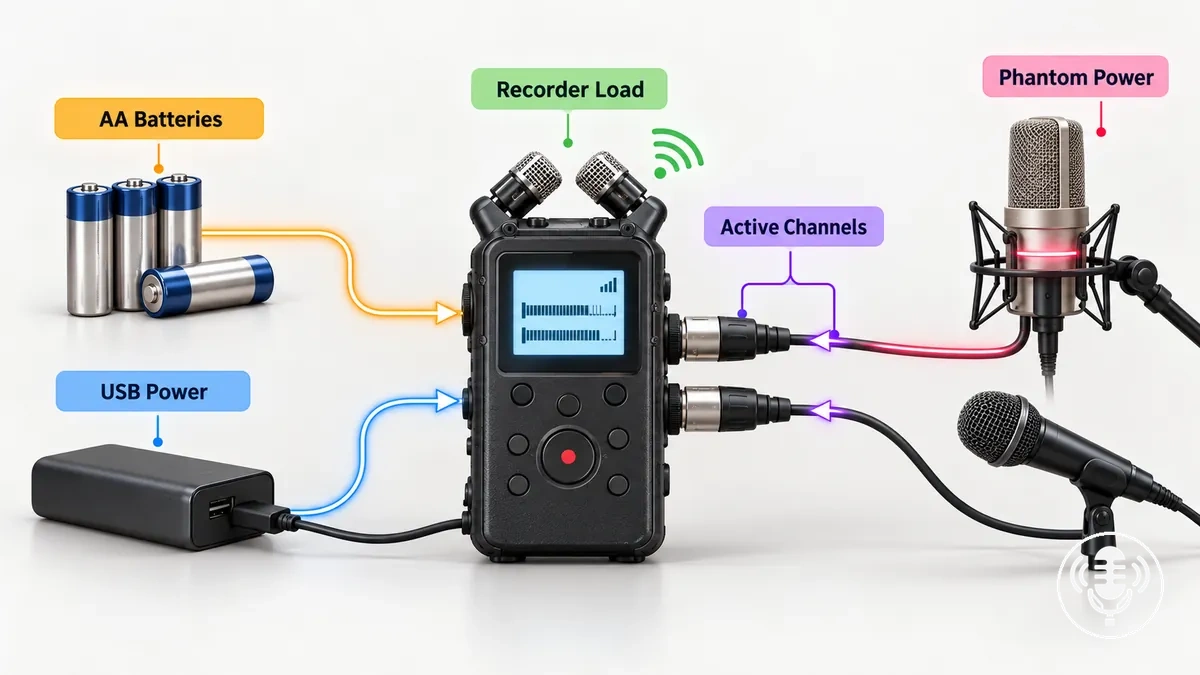
For a precise current or wattage value, use the manufacturer’s specification for the specific recorder and intended operating configuration. That model-specific demand is the appropriate value for checking source capability and estimating how quickly available energy will be used.
Factors That Determine Field Recorder Battery Life
Field recorder battery life is set by two sides of the same energy balance: how much usable energy the source can deliver and how quickly the recorder configuration consumes it. More usable energy supports longer runtime when load is comparable; greater electrical demand shortens runtime for the same usable energy.
Battery-side factors include capacity, state of charge, condition, chemistry, temperature and the recorder’s low-voltage cutoff. Cold conditions, ageing cells, partial charge and conversion losses can reduce the energy that is actually available to the recorder even when the headline capacity has not changed.
Load-side factors include active inputs, display or wireless functions where present, USB-connected or other powered devices, and channels supplying phantom power. These loads should be evaluated together because they all draw from the same available energy budget.
No single operating-time value applies across field recorders. Published or anecdotal runtimes are meaningful only when the recorder model, battery type, configuration, connected devices and test conditions are sufficiently similar to the intended session.
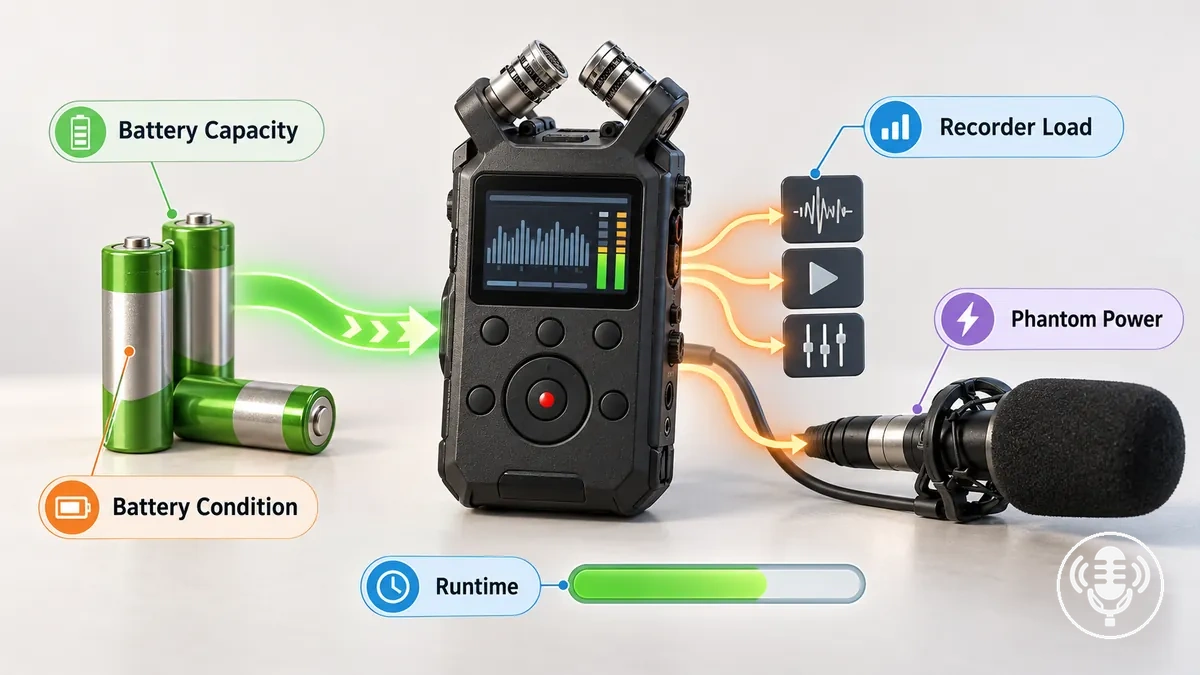
For the same recorder and battery, a lower-load configuration is expected to run longer than a higher-load configuration. The size of the difference remains configuration-specific, which is why runtime planning is more reliable when it uses usable watt-hours and average operating load rather than a battery-capacity label alone.
Battery Chemistry and Usable Capacity
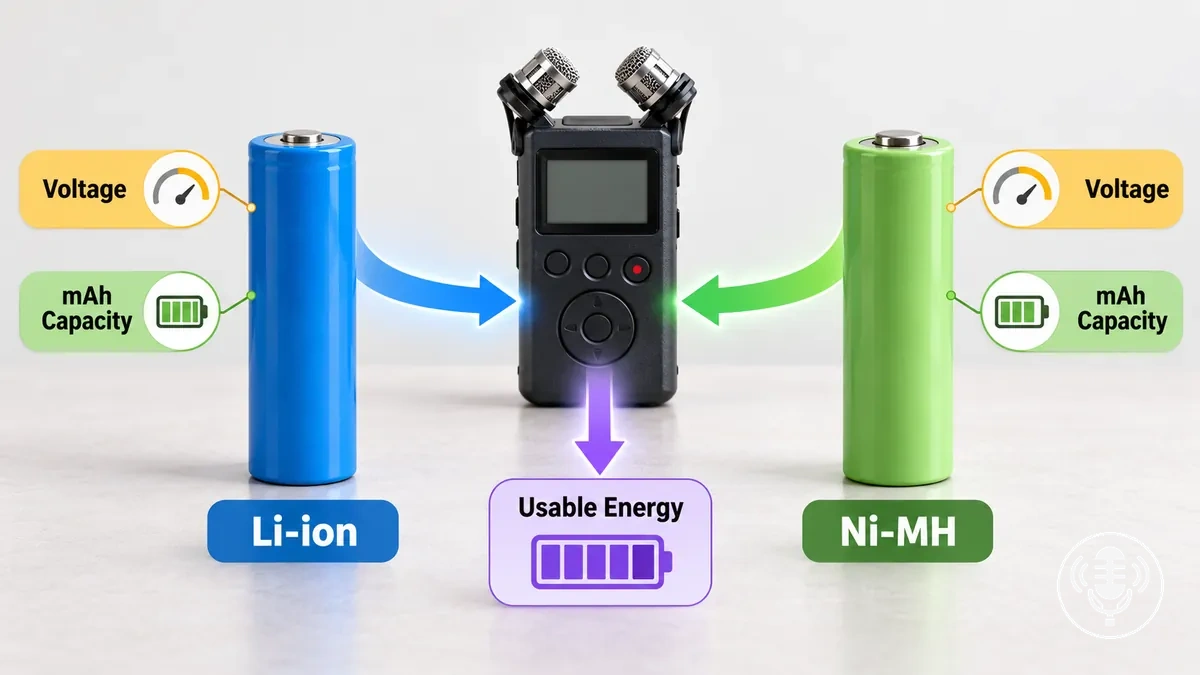
Battery chemistry affects nominal cell voltage and discharge behaviour, while a capacity rating in mAh measures electrical charge rather than guaranteed field-recorder runtime. Panasonic Energy specifies 1.2 V nominal for its Ni-MH cells and 3.60 V nominal for its NCR18650GA Li-ion cell example, illustrating why chemistry and cell type must remain attached to the stated voltage.
Battery energy in watt-hours relates charge capacity to voltage, so equal mAh ratings at different voltages do not represent equal nominal energy. When capacity is given in mAh, nominal energy is calculated as (mAh ÷ 1,000) × V = Wh.
| Battery chemistry | Voltage context | Capacity measure | Runtime implication |
|---|---|---|---|
| Ni-MH | Panasonic Energy specifies 1.2 V nominal voltage for its Ni-MH cells | mAh measures charge capacity and requires voltage context for energy comparison | Runtime depends on usable energy, recorder cutoff behaviour and recorder load |
| Li-ion | Panasonic Energy specifies 3.60 V nominal voltage for its NCR18650GA cell example | mAh measures charge capacity and requires voltage context for energy comparison | Runtime depends on usable energy, recorder cutoff behaviour and recorder load |
Usable capacity is the portion of stored energy that the field recorder can actually draw under the battery’s and recorder’s operating conditions. State of charge, discharge demand, temperature, internal resistance, battery condition, conversion losses and recorder cutoff behaviour can all reduce usable energy.
Equal mAh values are therefore not directly comparable across different voltages. For runtime planning, convert to a common energy unit and then account for the portion of nominal energy that is realistically usable in the intended power path.
Phantom Power and Connected Microphone Load
Phantom power can shorten field-recorder battery life because the recorder supplies additional electrical power to one or more connected microphones. That microphone demand becomes part of the recorder’s total load.
The common P48 phantom-power mode is nominally 48 V, but the microphone current drawn from that supply varies by microphone. Runtime impact therefore changes with microphone demand, the number of powered channels, the recorder’s phantom-power circuitry and efficiency, and any other functions active at the same time.
The power path runs from the recorder’s battery or external source, through the recorder’s phantom-power circuitry, to the microphone.
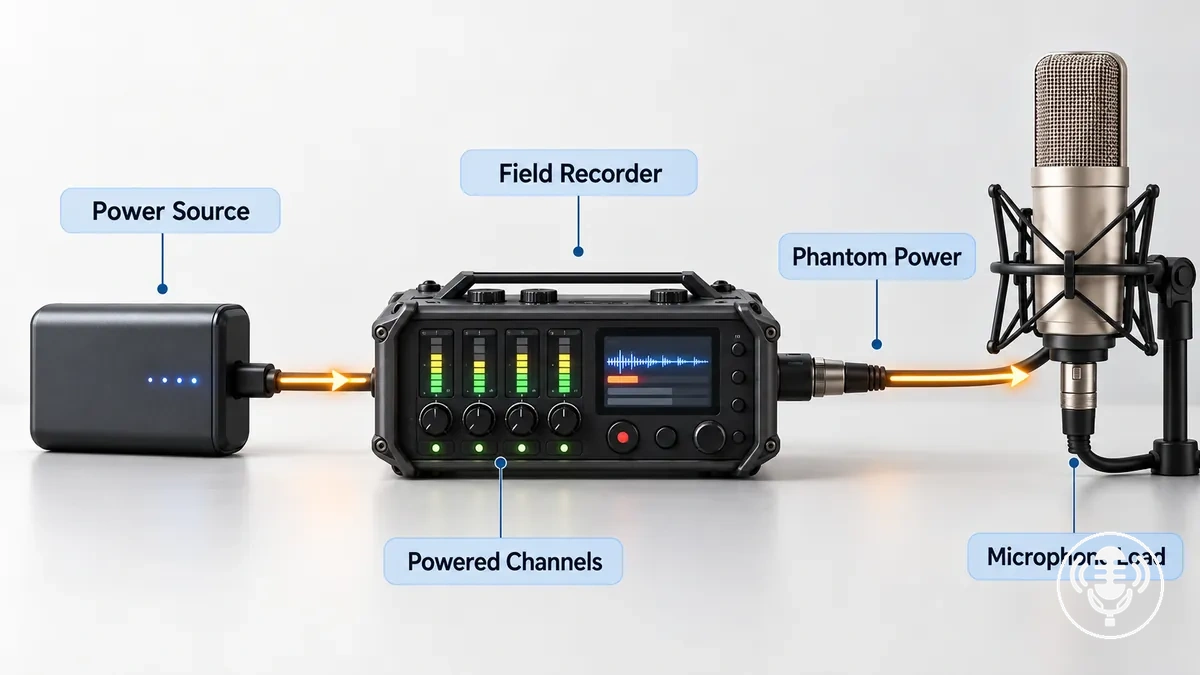
What changes the phantom-power load
- Phantom setting
- P48 is nominally 48 V; use only settings the recorder and microphone support.
- Powered channels
- Each additional phantom-powered channel adds another connected microphone load.
- Microphone demand
- Current draw differs by microphone, so two microphones can affect runtime differently.
- Other recorder functions
- Active channels, display, wireless or other powered features add separate demand where present.
A fixed runtime reduction should not be assumed without the specific recorder, microphone demand, powered-channel count and operating configuration. This microphone-related load is distinct from parasitic drain, which refers to unintended electrical loads in other contexts.
Battery and External Power Source Options for Field Recorders
Field recorder power options fall into four practical source classes: replaceable AA cells, rechargeable batteries, USB power from a power bank, and external power supplied through a supported battery pack or DC input. Some external systems use an NP-F battery or another rechargeable pack connected through a recorder-supported power path.
These sources differ in how energy is stored, replaced or recharged, carried and delivered. A source is usable only when the recorder supports its electrical output and connection path; stated battery capacity alone does not establish compatibility.
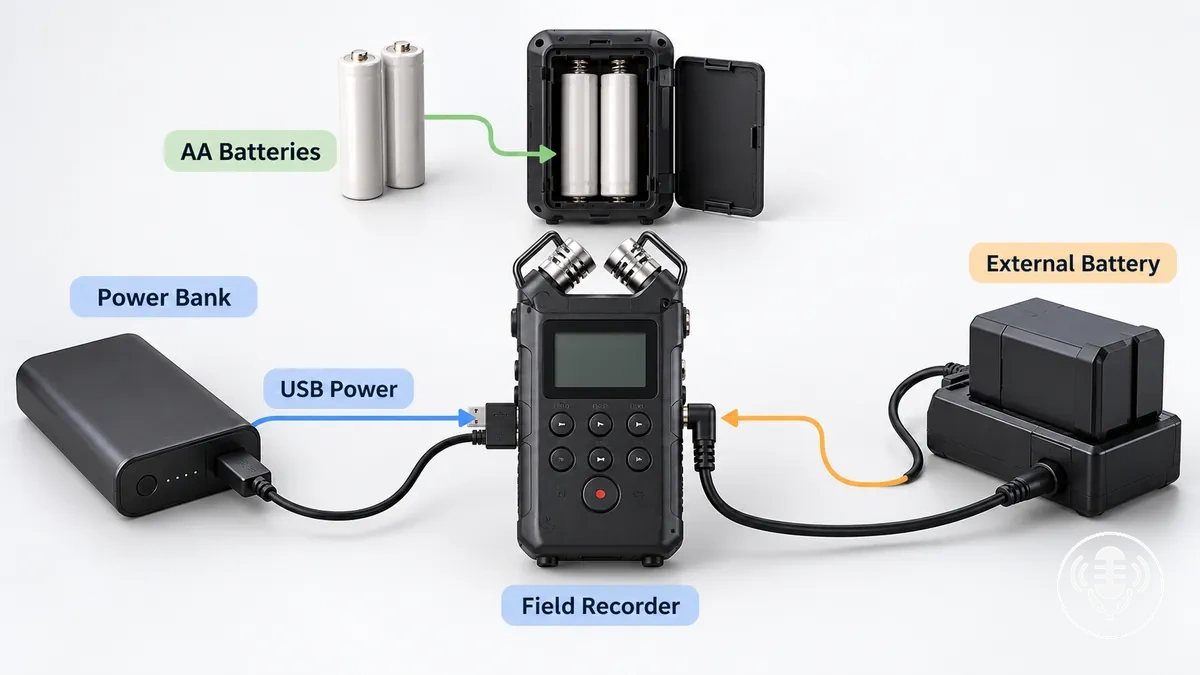
Replaceable cells are useful when rapid field exchange matters. A compatible power bank, external battery pack or DC source can provide a separate energy reserve for longer sessions, but it also adds a cable and an external power path that must remain practical during recording.
| Power source | Replaceable or rechargeable | Connection path | Practical strength | Compatibility condition |
|---|---|---|---|---|
| AA / rechargeable cells | Replaceable; rechargeable when rechargeable cells are used | Recorder battery compartment | Compact source that can be exchanged during a session | Recorder must support the required cell format and battery type |
| USB power bank | Rechargeable | Supported USB power input | External energy reserve where cabled powering is practical | Recorder must support USB-supplied operation and the source must meet its input requirements |
| External battery pack / NP-F battery | Rechargeable | Recorder-supported external-power path | Separate energy reserve for longer sessions | Battery system and connection path must meet the recorder’s supported input requirements |
| Supported DC or battery-sled source | Replaceable or rechargeable according to the battery system | Recorder-supported DC input or battery sled | Dedicated external-power path for a recorder designed to accept it | Source and connection path must meet the recorder’s documented power-input requirements |
The best-fit source is the one the field recorder supports and that provides enough usable energy for the intended session. Portability, rechargeability or replaceability, cable management and backup strategy are trade-offs rather than a universal ranking.
Replaceable and Rechargeable Batteries
Replaceable describes whether a battery can be exchanged in the field; rechargeable describes whether a cell or pack is designed to regain charge through an appropriate charger or charging system. A rechargeable AA cell can therefore be both replaceable and rechargeable.
Chemistry and format matter. A typical alkaline AA cell is nominally 1.5 V, while a Ni-MH AA cell is nominally 1.2 V; recorder support for a format or chemistry must be checked because voltage behaviour, low-voltage cutoff and battery-status indication can differ. Li-ion batteries use a different chemistry and may use a dedicated cell or pack format and charging path.
Choose by field workflow, not by label alone
Good fit when: you need fast swaps away from charging access and the recorder accepts the cell format.
Check: supported chemistry, cell condition, spare-cell storage and the recorder’s battery setting or cutoff behaviour where applicable.
Good fit when: repeat use and recharging between sessions are practical.
Check: chemistry-specific charging, recharge time, pack condition and whether the recorder actually supports in-device charging.
A recorder that accepts USB operating power should not be assumed to charge installed batteries. Powering the recorder and charging its battery are separate functions unless the recorder specification explicitly supports both.
USB Power Banks and External Battery Packs
A power bank or external battery pack can extend field recorder runtime only when the recorder supports the source’s electrical output and connection method. Capacity describes stored charge or energy; it does not establish electrical compatibility.
USB power can mean ordinary USB bus power or, where both devices support it, a negotiated USB-C power mode. An external battery pack may instead supply a recorder through a supported direct-DC path. A matching connector shape does not prove that the voltage, current capability or negotiated profile is suitable.
Check the complete power path before using capacity for runtime planning
- Supported output or negotiated profile: the source must provide the USB, USB-C negotiated mode or direct output required by the recorder.
- Voltage and current capability: delivered voltage must meet the supported input conditions, and the source must be able to supply at least the recorder’s required current.
- Connector and cable path: the cable must support the required electrical path, not merely fit mechanically.
- Recorder support for external power: the relevant input must be designed to power the recorder in the intended operating mode.
- Energy basis: interpret Wh directly when available; raw power-bank mAh should not be converted to recorder hours without the voltage associated with the rating and an allowance for conversion losses.
Internal-battery charging remains separate from powering the recorder. A recorder that accepts external USB power should not be assumed to charge an internal or installed battery unless that charging function is also documented.
For portable use, also consider cable security and pack placement so the supported power path remains practical throughout the recording session.
External Power Compatibility and Input Requirements
External power is compatible with a field recorder only when the recorder’s documented input requirements agree with the output the source actually delivers. A connector that physically fits establishes a mechanical connection, not electrical compatibility.
For a direct DC input, the source voltage must remain within the recorder’s documented range, polarity must match where specified, and the source must provide adequate current through the supported connector and cable. A source’s current rating may be higher than the recorder’s draw; what matters is that it can supply at least the required current while the voltage and polarity remain correct.
For USB power, recorder support determines whether ordinary USB power or a negotiated USB-C mode is accepted. Where negotiation is required, both the recorder and source must support the required power profile.
Verify every applicable condition
- Input type: use a documented external-power input, such as a supported USB or DC input.
- Voltage or negotiated profile: source output must remain within the recorder’s documented voltage conditions or supported USB power mode.
- Current capability: the source must meet or exceed the recorder’s required current for the intended operating load.
- Polarity: match the documented polarity for DC connections where polarity is specified.
- Connector and cable: use the supported connection path with a cable capable of carrying the required power.
Voltage ranges, USB-C behaviour, polarity and current requirements are model-specific. Use external power only within the manufacturer’s documented input limits and supported connection methods rather than extrapolating one recorder’s values to another.
Input Voltage Ranges and Power Connections
An input voltage range is the external-supply voltage range a field recorder is documented to accept through a specific power connection. It should not be inferred from the nominal voltage of the recorder’s internal batteries, because battery voltage and a regulated external-input requirement are different attributes.
Connection rule: all relevant conditions must agree
- Voltage
- Must stay within the documented input value or range for that connection.
- Current capability
- The source must be able to supply at least the recorder’s required current; a higher source current rating is not itself a problem.
- Polarity
- For DC inputs where polarity is specified, the source and cable must preserve that polarity.
- USB-C negotiation
- If the recorder requires a negotiated USB power mode, both devices must support the required profile.
- Connector and cable
- Physical fit is necessary but not sufficient; the connection must also carry the required electrical conditions.
No exact voltage range should be assumed without documentation for the specific recorder and input. External power should remain within the manufacturer’s documented electrical conditions and supported connection method.
Planning Battery Capacity and Backup Power for Recording Sessions
Battery capacity for a recording session should be planned from expected duration and the recorder’s operating load, then increased with a practical reserve. Longer runtime or greater load requires more usable energy, while battery condition, temperature, cutoff behaviour and conversion losses can reduce the operating time available from stored energy.
Backup power should cover plausible shortfalls and limited recharge or replacement opportunities rather than simply matching an optimistic runtime estimate. There is no universal reserve percentage: the useful margin changes with load variability, battery condition, environment and access to another supported source.
Build the session power budget in this order
- Set the expected session duration. Longer sessions require proportionally more usable energy when average load is unchanged.
- Define the intended recorder configuration. Include active inputs, phantom-powered channels and other functions that contribute to average load.
- Estimate usable energy. Account for battery condition, temperature, cutoff behaviour and conversion losses rather than treating nominal capacity as fully available.
- Retain a reserve. Choose a margin that reflects uncertainty and the consequences of losing power during the session.
- Choose a supported backup source. Spare cells, a compatible power bank or another documented external-power path can provide redundancy.
- Plan the switchover. Know how and when power can be changed without assuming the primary estimate will cover the entire session.
When charging or battery-replacement access is limited, reserve energy becomes more important because an optimistic estimate is harder to recover from in the field. The final plan should therefore record the intended configuration, usable energy assumption, expected duration, reserve, backup source and switchover method.
Estimating Runtime from Battery Capacity and Recorder Power Draw
A runtime estimate requires battery energy and field recorder power draw in compatible units. When energy is already stated in Wh, estimated operating time is usable Wh divided by average power draw in W. When capacity is stated in mAh, voltage is also required because mAh alone cannot determine energy.
Use (mAh ÷ 1,000) × V = nominal Wh, then reduce nominal Wh by an explicit usable-energy assumption that represents the expected battery condition, conversion losses, cutoff behaviour and operating environment. Include phantom power and other powered functions in average recorder load when they are active.
- Identify capacity and voltage: use Wh directly, or retain both mAh and the voltage associated with that rating.
- Convert to watt-hours: mAh ÷ 1,000 = Ah; Ah × V = nominal Wh.
- Estimate usable energy: apply an explicit usable-energy percentage appropriate to the planned battery and power path.
- Establish average load: use watts for the intended recorder configuration, including powered microphones and other active loads where applicable.
- Calculate and reserve: usable Wh ÷ average W = estimated hours; then retain the chosen reserve instead of treating the full estimate as guaranteed operating time.
For power banks, use the rated Wh value when the manufacturer provides it. If only mAh is used, keep the voltage associated with that capacity rating; substituting the recorder input voltage can misstate stored energy.
The result remains a planning estimate rather than guaranteed runtime because real load and usable energy can change during the session.