
Choosing Field Recording Equipment for Your Recording Needs
Choose field recording equipment by working from the recording task outward: define the sound source and environment, decide how many independent signals must be captured, then select a recorder and microphone that satisfy the required input, power, monitoring, noise-performance and portability conditions. Compatibility is a pass/fail screen; compare extra features and budget only after every must-have recording path and support requirement is satisfied.
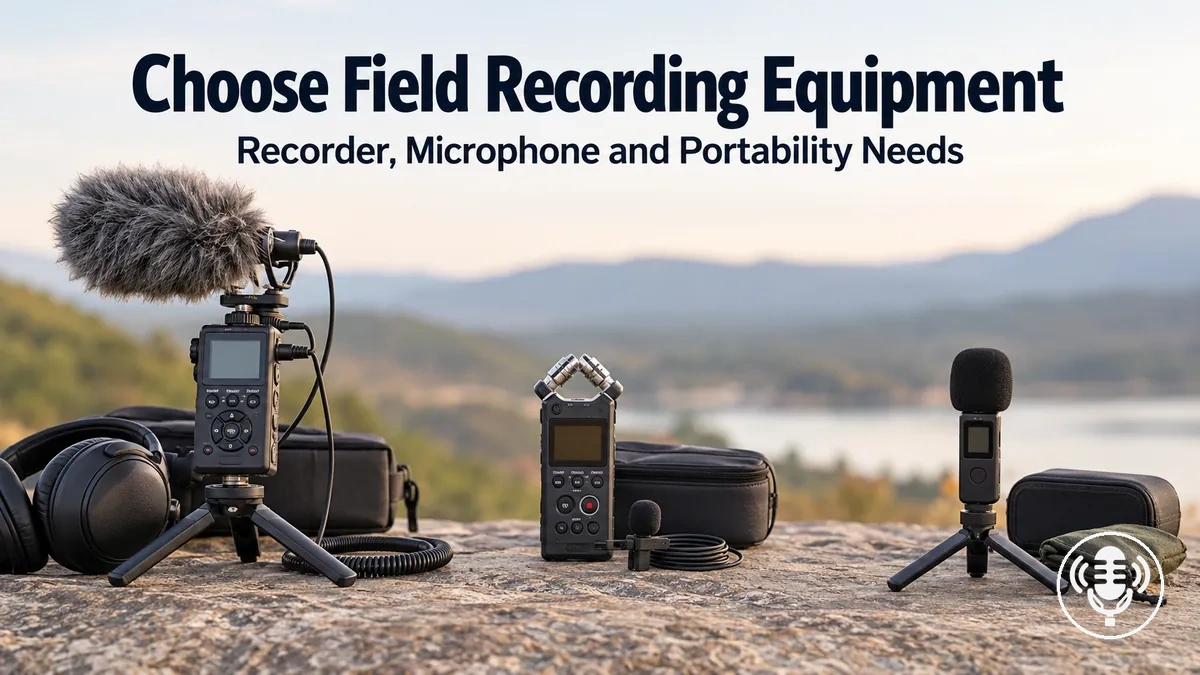
Build your field-recording priority profile
Choose the recording conditions first. The guide returns the signal-path requirement, the main equipment priority and the compatibility checks to verify before comparing products.
How the result works: mono requires one independent recording path; stereo requires two; simultaneous independent signals require one path per signal. External microphones also require a compatible recorder input, any required microphone power and a complete signal path.
Choose the three core conditions above, then evaluate the setup.
The recorder and microphone should suit the sound source, recording environment and capture method, while the supporting kit should meet the session's monitoring, power, protection and mobility needs.
Table of Contents
Recording Goals and Conditions That Determine Equipment Suitability
Recording goals and recording conditions determine which capabilities a field recording setup requires.
Must-have requirement
A capability the setup needs to complete the intended recording, such as the required capture mode, monitoring path, wind protection or session support.
Preference
A feature that can improve convenience or flexibility but does not determine whether the intended recording can be completed.
Translate the recording goal into verifiable requirements for capture mode, portability, wind protection, monitoring, session support and budget.

Use this checklist to verify which capabilities the intended recording requires and to separate those must-haves from preferences.
- Sound source: identify whether the recorded sound is quiet or loud, close or distant, and steady or changing; those conditions determine which microphone and recorder characteristics need priority.
- Mono or stereo capture: require mono when the recording goal calls for one channel of sound, or stereo when it calls for left-right spatial information.
- Signal conditions: for quiet sources, prioritise a recording chain that does not mask subtle sound with unwanted noise; for louder or closer sources, prioritise equipment that can accommodate the expected signal without unwanted distortion.
- Wind and outdoor exposure: include suitable wind protection when the microphone will be exposed to moving air; sheltered conditions reduce that exposure-related requirement.
- Portability: prioritise a setup that can be carried and operated within the movement and location constraints of the planned session.
- Monitoring and session support: require monitoring when the recording must be checked during capture, and match power and recording support to the intended session duration and operating conditions.
- Budget: allocate the available budget to required capture, protection, portability, and monitoring capabilities before preference-based features.
Sound Source and Recording Environment
The sound source and recording environment determine which noise, directionality, protection and handling attributes deserve priority.
Quiet or distant source
Give greater weight to microphone self-noise, recorder noise performance and control of competing background sound because the wanted signal is comparatively subtle.
Loud or close source
Prioritise handling the incoming signal appropriately; equipment-noise figures generally become less dominant relative to a stronger wanted signal.
Distance and directionality
Source-to-microphone distance and microphone directionality change the balance between the intended sound and surrounding sound, so both should match the recording context.
Wind or movement
When moving air reaches the microphone, suitable wind protection and practical handling become part of the recording requirement.
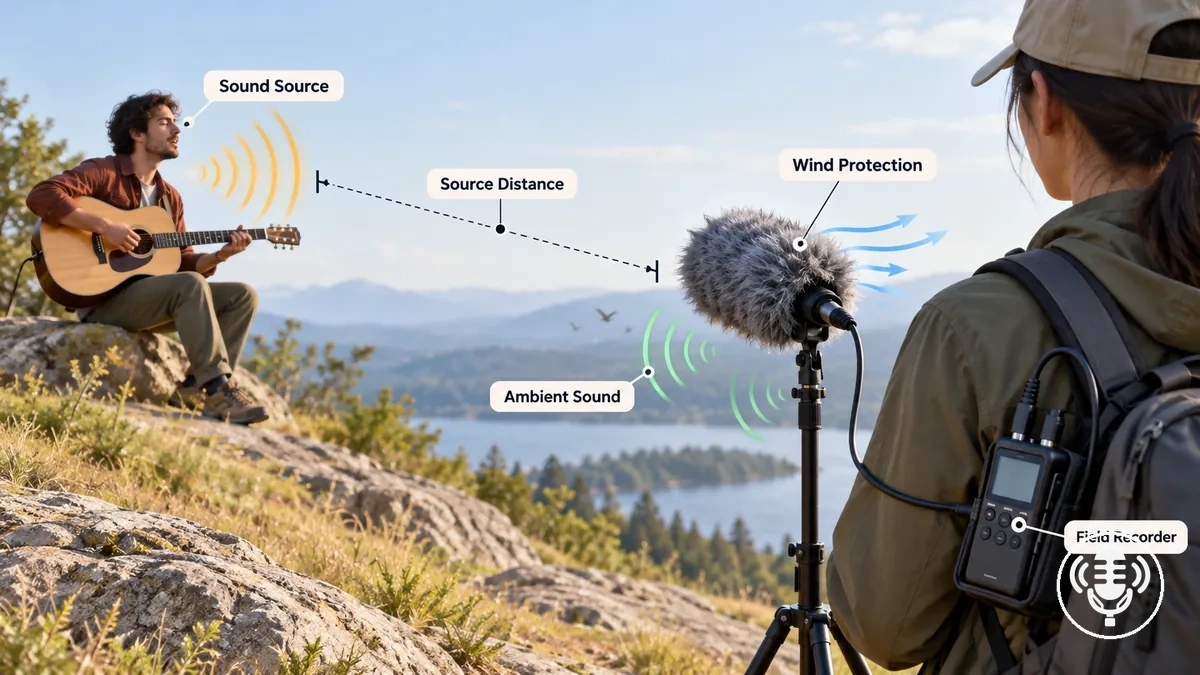
The setup is suitable when its noise performance, microphone behaviour, protection, portability and handling match the actual source position and recording conditions.
Mono, Stereo, and Simultaneous Capture Needs
Capture mode sets the minimum number of independent signal paths the recording setup must provide.
- Mono
- 1 independent recording path for the mono signal.
- Stereo
- 2 independent recording paths for left and right signals.
- Several simultaneous independent signals
- 1 independent path per signal that must remain separately recorded.

The microphone arrangement and field recorder must provide the inputs, recording paths and monitoring needed for the selected capture mode; extra channels add no benefit unless the recording plan can use them.
Recorder and Microphone Priorities Within the Setup
Prioritise the field recorder or microphone according to which component limits the intended recording.
If the field recorder constrains required inputs, monitoring, quiet-recording performance, or support for an external microphone, recorder capability becomes the priority; if the microphone does not suit the sound source or required capture characteristics, microphone suitability becomes the priority.
Budget should therefore follow the limiting part of the signal chain while preserving the sound quality and versatility the recording requires.
Neither component is the universal priority across every setup.
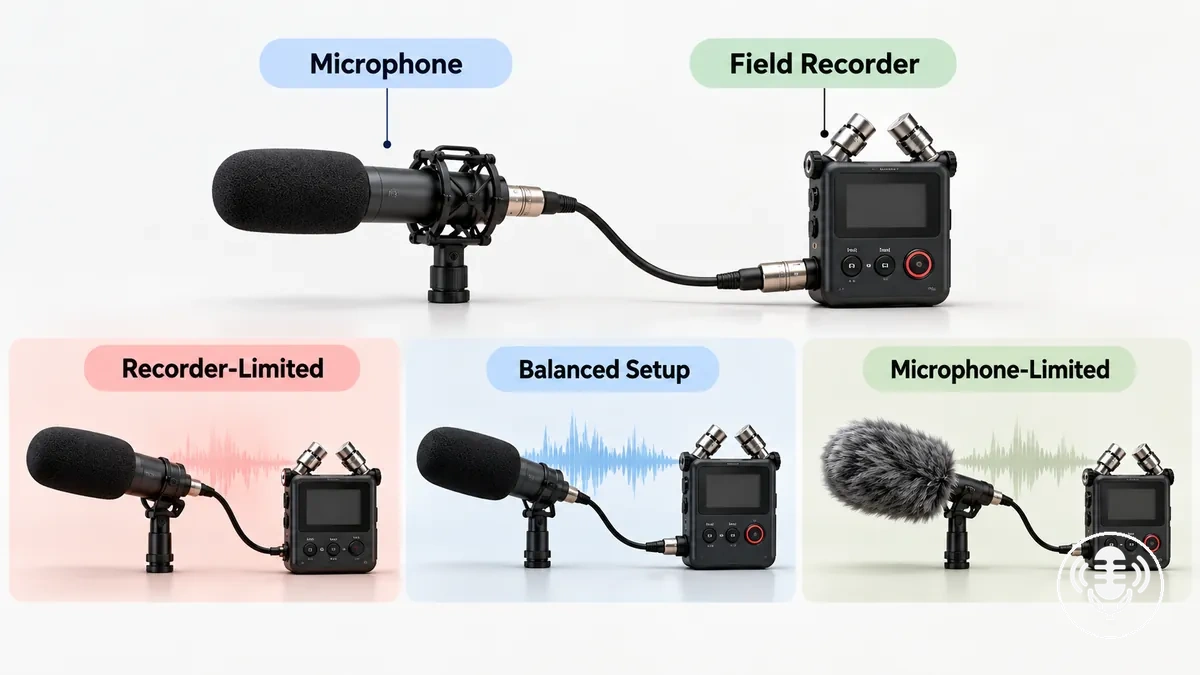
The table applies the same decision criteria to recorder-limited, microphone-limited, and balanced conditions.
| Limiting area | Typical condition | What it affects | Priority implication |
|---|---|---|---|
| Recorder-limited | The microphone suits the source, but the field recorder lacks a required capability in recorder noise performance, channel capacity, connectivity, monitoring, or workflow support. | Whether the setup can support the required capture path and operating conditions. | Prioritise the field recorder capability that resolves the identified recorder-side constraint. |
| Microphone-limited | The field recorder supports the required capture, but the microphone characteristics do not suit the sound source or recording conditions. | Source matching and the microphone's suitability for the intended sound capture. | Prioritise microphone characteristics that address the identified source or recording-condition requirement. |
| Balanced / no clear bottleneck | The field recorder and microphone both satisfy the required source matching, recording paths, connectivity, monitoring, and workflow conditions. | Neither component creates the current suitability constraint. | Allocate budget according to the next unmet recording need rather than prioritising either component by default. |
When Recorder Capability Is the Limiting Factor
A field recorder becomes the limiting factor when the recording setup requires an input count, gain handling, recorder noise performance, power support, recording capability, monitoring, or operational reliability that the recorder cannot provide.
- Inputs and recording paths: the recorder must provide every input and independent path the intended capture requires.
- Gain and noise performance: quiet material makes recorder/input noise relevant when it competes with the wanted signal.
- External-microphone support: the recorder must provide the required connection and microphone power when the chosen microphone depends on them.
- Monitoring and session support: monitoring, power and operational reliability must support the planned field session.
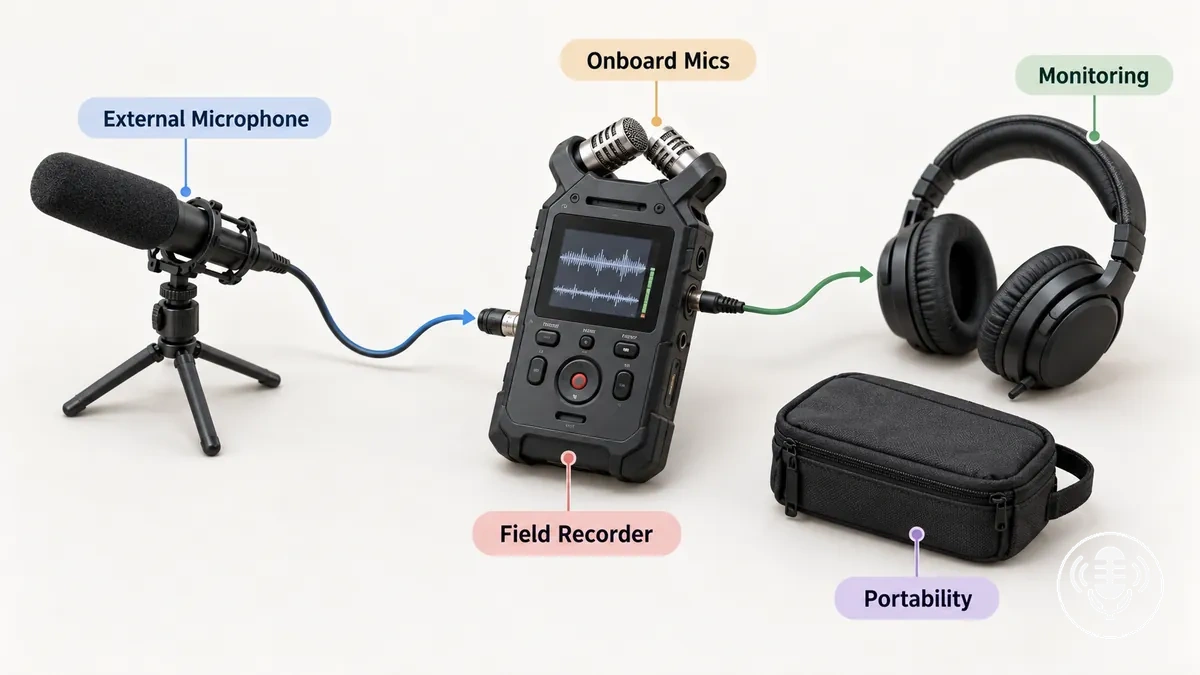
Choose greater recorder capability only when a recorder-side requirement prevents the current setup from meeting the intended recording need.
When Microphone Choice Is the Limiting Factor
A microphone becomes the limiting factor when the field recorder is otherwise suitable but the microphone does not match the sound source, required capture style, or recording conditions.
- Capture configuration
- The microphone arrangement must support the intended mono or stereo capture.
- Directionality and sensitivity
- These should suit the source position, wanted sound and surrounding sound in the intended environment.
- Self-noise
- It becomes more important when quiet or subtle material must remain distinguishable.
- Maximum sound-level capability
- It matters when the intended source is loud enough to challenge the microphone's clean operating range.
- Environmental suitability
- When moving air reaches the microphone, suitable wind protection becomes part of the requirement.
Onboard microphones can remain suitable when their configuration and environmental behaviour meet these conditions; choose an external microphone only when it resolves a specific source, capture, noise or environmental limitation.
Technical Criteria for Recording Performance and Compatibility
Technical criteria should first separate capabilities that the field recorder and microphone must provide from performance preferences that can be traded against cost, size, or convenience.
Must pass
Required input and channel capacity, connector support, microphone power where needed, monitoring and the intended capture format. If a required capability is unsupported, the setup fails that requirement.
Compare after compatibility
Portability, build quality and extra features can be traded against cost, size or convenience only after the mandatory signal-path and session requirements are satisfied.
Sound quality is a system result: judge the microphone, recorder, source and recording conditions together rather than treating one specification as a universal quality score.
Microphone self-noise becomes a relevant criterion when it could interfere with quiet recording, while signal-to-noise ratio is useful for comparison when its measurement conditions and the intended signal are applicable to the recording need.
Field recorder features such as input capacity, gain handling, monitoring, and capture flexibility should likewise be screened against the required recording rather than ranked by numerical size or feature count.
These performance attributes matter when they constrain the required capture, acceptable noise, or monitoring conditions.
Self-Noise and Signal-to-Noise Performance
Noise performance matters most when the wanted signal is quiet enough for microphone self-noise, field recorder noise, or background noise to become meaningful relative to that signal.
- Microphone self-noise
- Noise contributed by the microphone itself.
- Recorder noise
- Noise contributed by the field recorder or its input stage.
- Signal-to-noise ratio
- The relationship between the wanted signal and the noise against which it is measured; compare it only when the measurement context is relevant.
- Environmental background noise
- Sound in the recording environment, distinct from noise generated by the microphone or recorder.
There is no universal noise-specification threshold for every field recording: the practical requirement changes with source level, microphone position, background noise and recording conditions.
When the wanted source reaches the microphone more strongly, such as with a louder source or a suitable closer position, equipment noise becomes less significant relative to that signal.
Inputs, Channels, and Connection Requirements
The field recorder, microphone, monitoring path and capture requirement must form a complete compatible signal path.
Complete signal-path check
- Microphone-to-recorder connection: Pass when the microphone output and connector match a supported field recorder input; treat an adapter as conditional until the resulting connection is confirmed to satisfy the required electrical and signal conditions.
- Recording paths: Pass when the field recorder provides at least one independent recording path for each signal that must remain independently recorded during simultaneous capture; fail when the required signals exceed the available simultaneous recording paths.
- External microphone support: Pass when the field recorder provides the input type and connection support required by the external microphone; fail when the required microphone connection is unsupported.
- Power dependency: Pass when the recording setup supplies the power method required by the chosen microphone, including phantom or plug-in power when that specific microphone requires it; fail when the required power method is unavailable.
- Headphones and monitoring: Pass when the field recorder provides a suitable output for the required headphones or monitoring path; fail the monitoring requirement when the required monitoring path cannot be supported.
- Cables and adapters: Pass when the required cables and any necessary adapters complete the intended signal path without an unresolved connector, signal, or power mismatch; treat the connection as conditional while any of those dependencies remains unverified, and as failed when a required dependency is unsupported.
Portability, Build Quality, and Capability Trade-Offs
Portability, build quality, and recording capability should be balanced against how the field recorder and recording kit will be carried and used in the field.
Do not infer sound quality from recorder size or weight. Assess sound quality against the recording-performance requirements of the intended setup.
A smaller field recorder is therefore preferable only when its capabilities, control access, and build quality still satisfy the intended recording conditions.
Build quality should be judged from documented construction or protection characteristics relevant to field use rather than rugged appearance alone; detailed durability and ruggedness criteria require their own evaluation.
Budget constrains which combination is practical, but higher cost or greater physical mass does not by itself establish better sound quality or resilience.
The Portability, Build Quality, and Capability Trade-Offs table compares physical constraints and capability consequences on the same basis.
| Attribute | Lightweight setup | Higher-capability setup | Selection implication |
|---|---|---|---|
| Portability / carry burden | Lower size, weight, or accessory burden supports conditions that require frequent carrying, repositioning, or quicker setup. | Additional hardware, controls, or accessories increase carry burden when they are part of the required configuration. | Prioritise portability when carrying time, movement, or setup speed constrains the recording kit; accept additional burden when required capability justifies it. |
| Power / accessory burden | Fewer required accessories or power dependencies reduce the supporting equipment that must be carried and managed. | Additional capabilities increase accessory or power burden when those functions require supporting equipment in the intended setup. | Compare the complete recording kit rather than the field recorder alone, retaining every power or accessory dependency required by the recording task. |
| Build resilience | A lightweight setup remains suitable when its documented construction and protection characteristics satisfy the expected field-use conditions. | Additional physical mass or size does not by itself establish greater durability or protection. | Compare documented build protection against the intended field conditions rather than using appearance, size, or weight as a proxy for resilience. |
| Recording capability or sound/noise priorities | A lightweight setup remains suitable when it provides the required channel capacity, control access, monitoring, and recording performance. | Additional capability becomes relevant when the recording need requires channels, controls, monitoring, or performance that the lighter configuration does not provide. | Choose capability according to the recording-performance requirement; do not infer sound quality from portability, size, weight, or feature count alone. |
Budget Allocation Based on Recording Priorities
Budget should first fund the field recorder, microphone, and essential support requirements without which the intended recording cannot be completed.
Recorder capability becomes a spending priority when required inputs, recording paths, monitoring, or power support are missing, while microphone suitability takes priority when the microphone does not meet the required source or capture conditions.
Essential protection, power, storage, and monitoring should be funded when the planned recording depends on them; optional improvements can wait when they do not remove a current limitation.
The priority is to satisfy must-have recording requirements before spending on preference-based improvements.
Allocation should follow the limiting requirement rather than a fixed percentage or price range: fund the field recorder when recorder capability is the constraint, the microphone when microphone suitability is the constraint, and support items when they are necessary to complete or sustain the recording.
| Priority | Budget condition | Fund first | Can wait if non-essential |
|---|---|---|---|
| Recorder capability | The current field recorder lacks an input, recording path, monitoring function, power support, or other capability required for the intended capture. | The recorder capability that removes the identified recording constraint. | Additional recorder features that do not satisfy a current recording requirement. |
| Microphone suitability | The recorder meets the required capture conditions, but the microphone does not suit the source, capture method, or relevant noise requirement. | The microphone capability that resolves the identified source or capture limitation. | An external microphone when onboard mics already satisfy the required capture conditions. |
| Essential protection / support | The recording conditions require protection or support for the microphone, field recorder, or intended capture. | The protection or support item required for those specific recording conditions. | Support accessories that do not address a requirement of the planned recording. |
| Monitoring / power / storage support | The planned session requires monitoring, sufficient power support, or sufficient storage to complete the intended recording. | The missing monitoring, power, or storage capability required to complete the planned session. | Additional capacity or accessories beyond the requirements of the intended session. |
| Portability | Carrying burden, movement, or field operation makes the size or complexity of the recording kit a practical constraint. | Changes that reduce the relevant carrying or operating burden while retaining required recording capability. | Portability improvements when the existing recording kit already meets the movement and carrying conditions of the session. |
Constrained budget
A simpler recorder using onboard microphones can be good value when its recording paths, monitoring, power, storage and microphone configuration already satisfy the core recording needs. Defer an external microphone or accessory when it does not remove a current bottleneck.
Larger budget
Spend more when it removes a genuine limitation: microphone suitability, recorder capability, power, storage, monitoring, build requirements or portability. Higher expenditure alone does not establish better sound quality or greater value.
Allocate the available budget according to unmet requirements and limiting factors, not price alone.
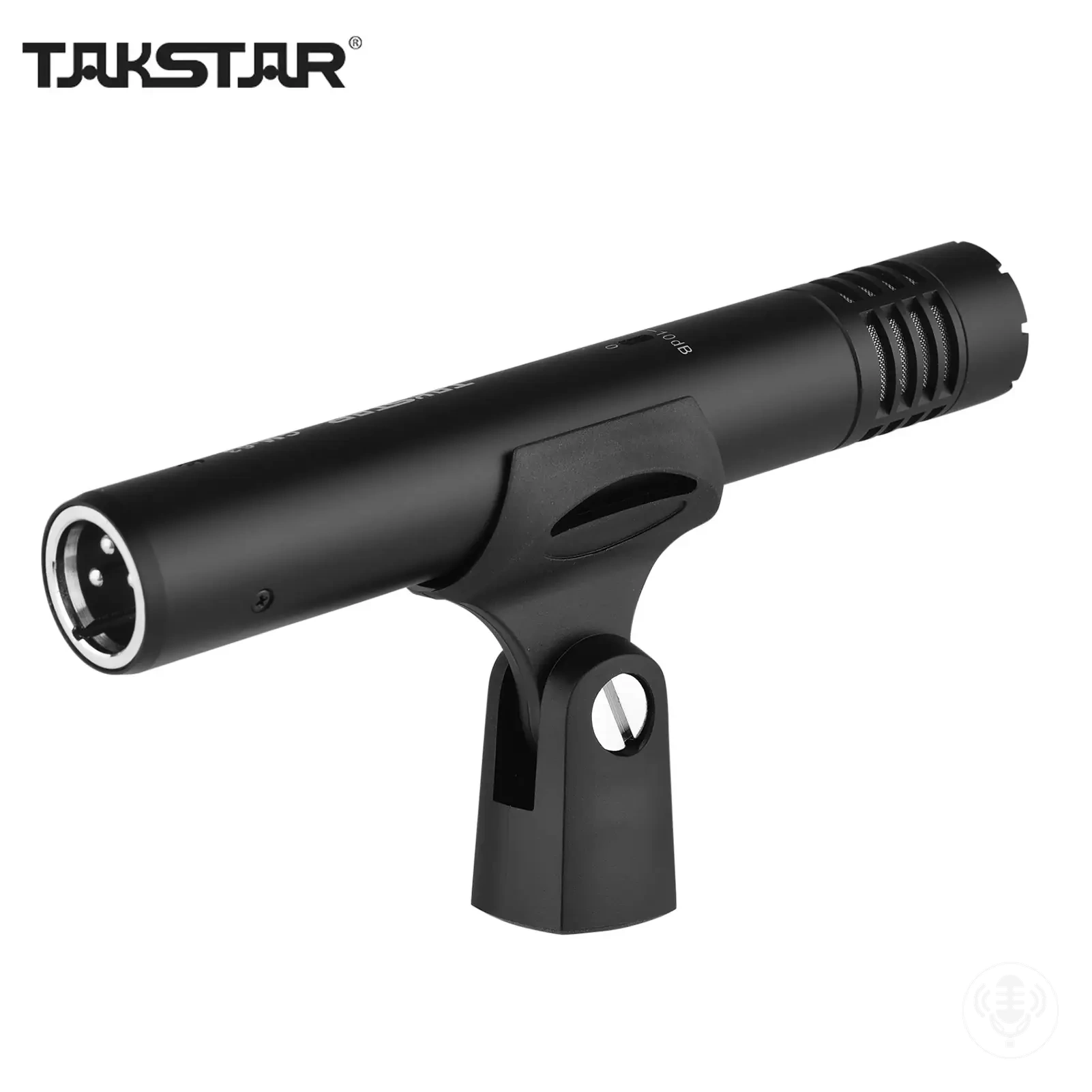
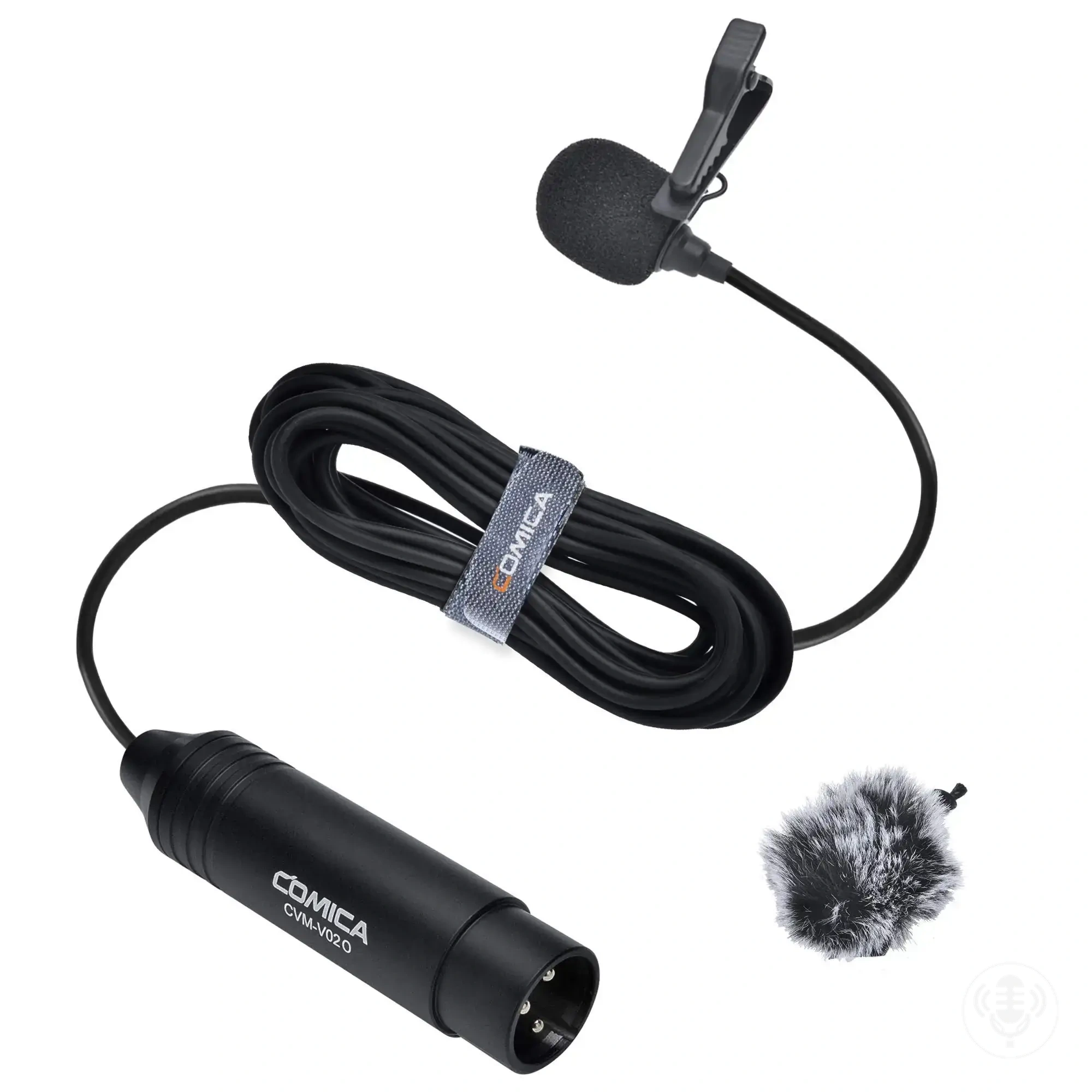
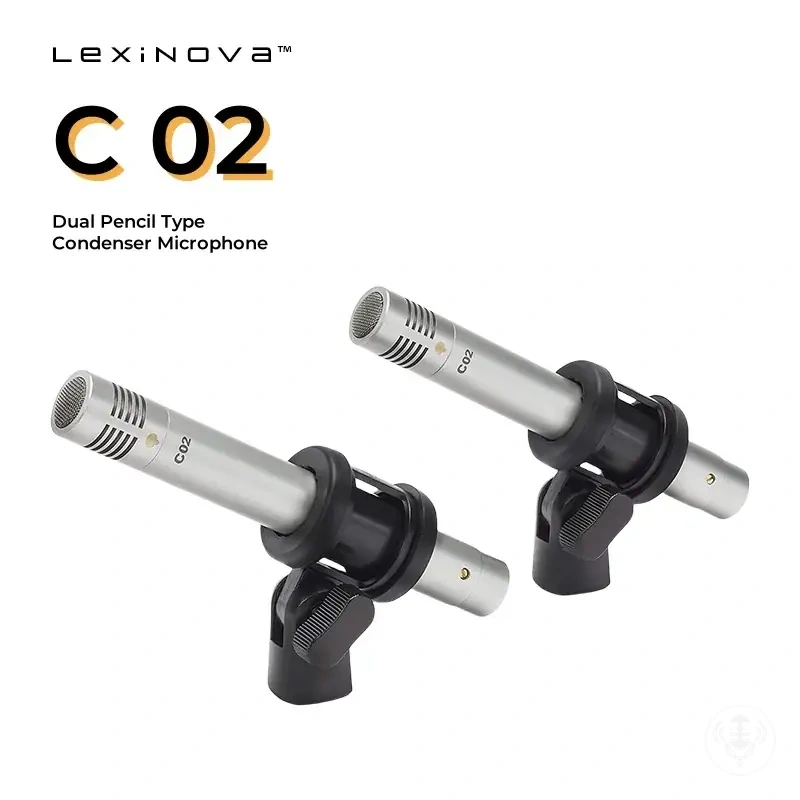
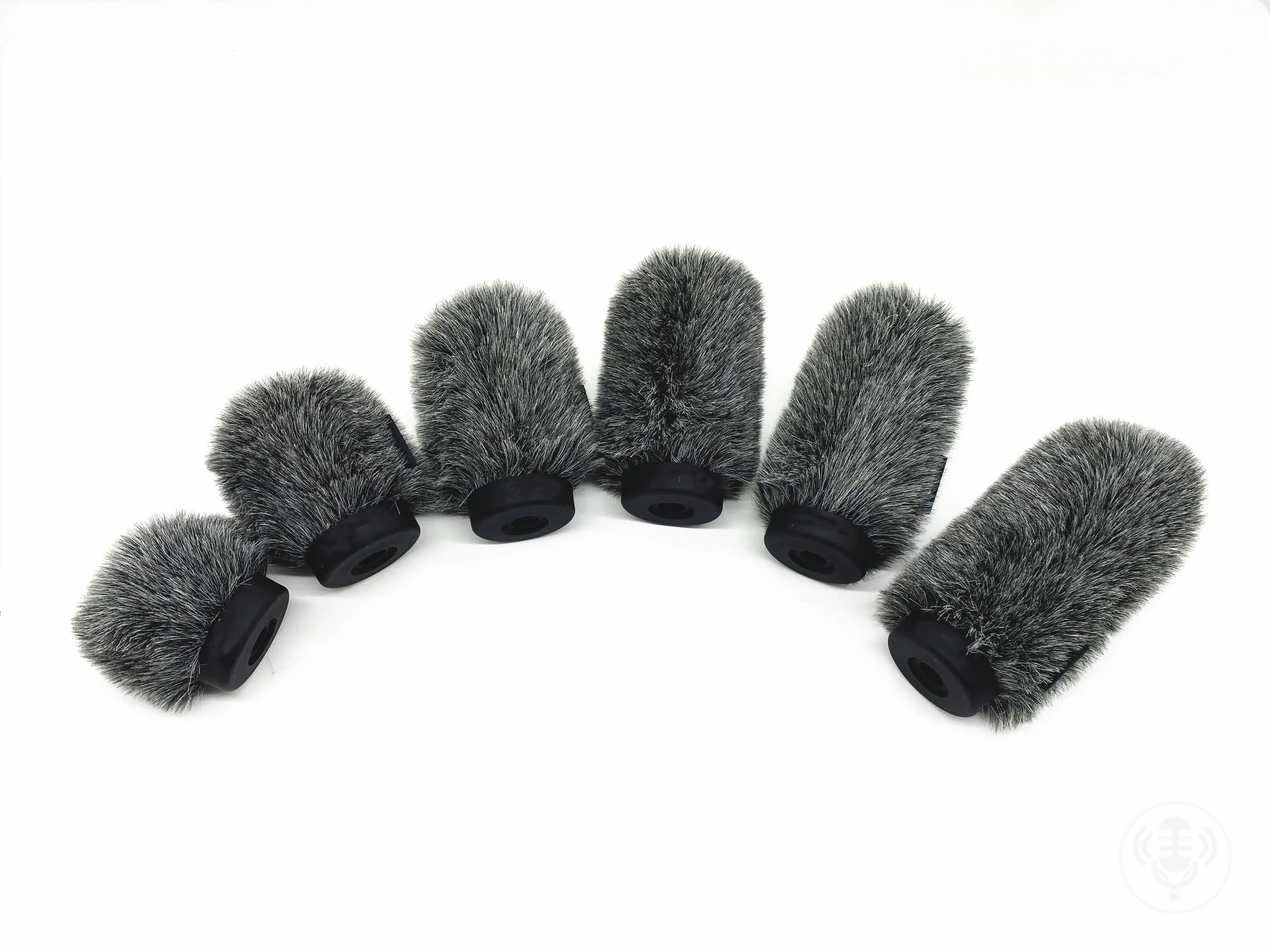
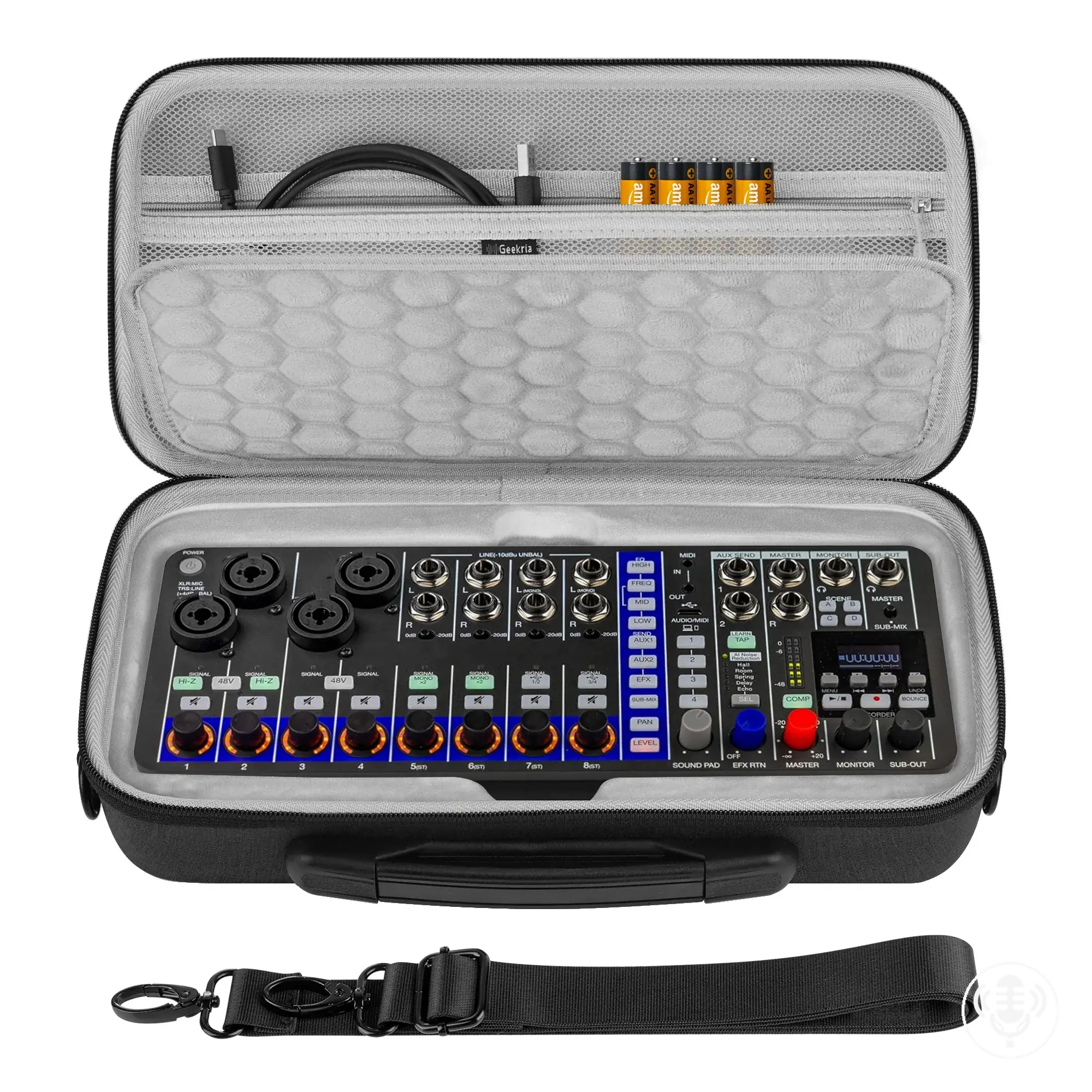
The products below are useful examples for comparing available options.
Before buying, check that the compatibility criteria, key features, and product details match your needs.
Final Compatibility and Completeness Checks Before Purchase
The final check should confirm that the field recording setup can complete the intended recording without a missing compatibility or essential-support dependency.
The field recorder, microphone, capture mode, monitoring, power, storage, protection, portability, and required accessories should each support the conditions in which the setup will be used.
Pass
The stated requirement is satisfied.
Conditional pass
Suitability still depends on a specific configuration or recording condition that must be verified.
Fail
A required dependency is unsupported; revisit the requirement or the component responsible.
Final must-have checklist
- Recorder-microphone fit: Pass when the microphone connection, required power, and field recorder input support the intended configuration; conditional-pass when suitability depends on a specific adapter or configuration that still requires verification; fail when a required input or power dependency is unsupported.
- Capture requirement: Pass when the field recorder provides the recording paths required for the intended mono, stereo, or simultaneous capture; fail when the available recording paths do not support the required capture.
- Connection completeness: Pass when every required microphone-to-recorder and monitoring connection has the necessary compatible cables or interfaces; conditional-pass when an adapter or interface dependency remains to be verified; fail when a required connection cannot be completed.
- Headphones and monitoring: Pass when the field recorder supports the headphones or monitoring path required for the intended recording; fail when monitoring is required but the setup provides no suitable monitoring path.
- Power: Pass when the planned setup provides the power required by the field recorder, microphone, and required accessories under the intended session conditions; conditional-pass when adequacy still depends on the selected power configuration; fail when a required component cannot be powered.
- Wind protection: Pass when suitable wind protection is included where the microphone will be exposed to moving air; conditional-pass when expected wind exposure has not yet been established; the check is not applicable when moving-air exposure is outside the intended recording conditions.
- Storage: Pass when the field recorder supports the selected storage media and the available capacity satisfies the intended recording configuration and session requirement; conditional-pass when media compatibility or required capacity remains unverified; fail when the required storage configuration is unsupported.
- Portability and handling: Pass when the complete recording kit can be carried, positioned, and handled within the movement requirements of the planned field use; conditional-pass when the final mounting or accessory configuration could change that burden.
- Required support accessories: Pass when every cable, mount, protection item, or other accessory required by the chosen setup is accounted for; optional equipment is not a completeness requirement when the intended recording does not depend on it.
- Budget fit: Pass when the available budget covers every must-have component and support dependency identified by the recording requirements; fail when a required dependency remains unfunded, in which case non-essential additions should be deferred before removing a must-have requirement.
If a checklist item fails, revisit the requirement or the component responsible for that dependency rather than adding unrelated equipment.
A conditional-pass should remain conditional until the specific connection, power, storage, protection, monitoring, or configuration dependency has been verified for the intended setup.
The setup is ready for product comparison when every must-have requirement passes and no unresolved conditional check could prevent the intended recording.
The products below are useful examples for comparing available options.
Before buying, check that the compatibility criteria, key features, and product details match your needs.