
Field Recording Equipment Components and Their Roles
Field recording equipment must cover capture and recording. A microphone captures acoustic sound and a field recorder records it; monitoring and support functions are added when the recorder design, field conditions, session duration, or handling requirements make them necessary. A complete setup is defined by the functions it covers, not by a fixed number of separate items, because one device can integrate several roles.
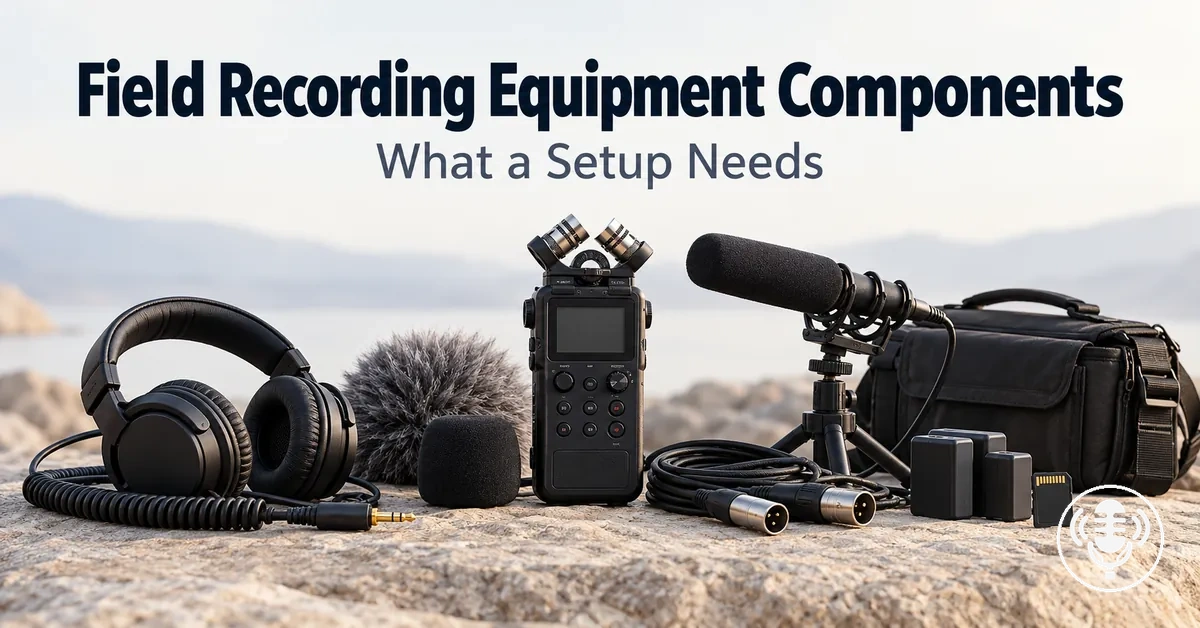
At a glance: how the setup fits together
Use the role first, then decide whether that role needs its own physical component in your configuration.
Integration rule: if the recorder already provides a required function, you do not need a separate item solely to duplicate that function.
The sections below separate core signal-path roles from condition-dependent support, then show how each role changes the physical setup.
Table of Contents
What Counts as a Field Recording Equipment Component
A field recording equipment component is a functional part that performs either a core signal-path role or a supporting role. The core roles are capture, recording, and monitoring; support roles become relevant when the environment or configuration creates an additional requirement.
This role-based definition separates what the setup must do from how many physical items it uses.

- Core signal-path roles
- Capture is performed by a microphone, recording by the field recorder, and monitoring through a recorder output such as headphones.
- Supporting roles
- Protection, mounting, power, storage, connection, and transport support the recording chain only when the corresponding condition exists.
- Integration rule
- Several roles can exist inside one device. A field recorder with built-in microphones, for example, combines capture and recording without requiring a separate microphone for that same capture role.
A named function therefore identifies a role in the setup, not a mandatory standalone accessory in every configuration.
Core Components in the Field Recording Signal Path
The core field-recording path is sound source → microphone → field recorder. The microphone converts acoustic sound into a signal the recorder can receive, and the recorder creates the recorded audio.
Monitoring branches from the recorder output so headphones can make that output audible to the operator without taking over capture or recording.

Occupies the capture role between the sound source and the recorder.
Receives the capture signal and writes recorded audio to supported storage.
Lets the operator hear what is present at the monitored output; it does not substitute for capture or recording.
The physical device count can be lower when these roles are integrated into one recorder, but the functional sequence remains the same.
Microphones for Sound Capture
A microphone is the sound-capture component: it converts acoustic sound into a signal for the field recorder.
Two attributes matter directly to that capture role: the microphone's pickup behaviour and its position relative to the sound source. Together they influence how strongly the intended source and surrounding sound contribute to the captured signal.
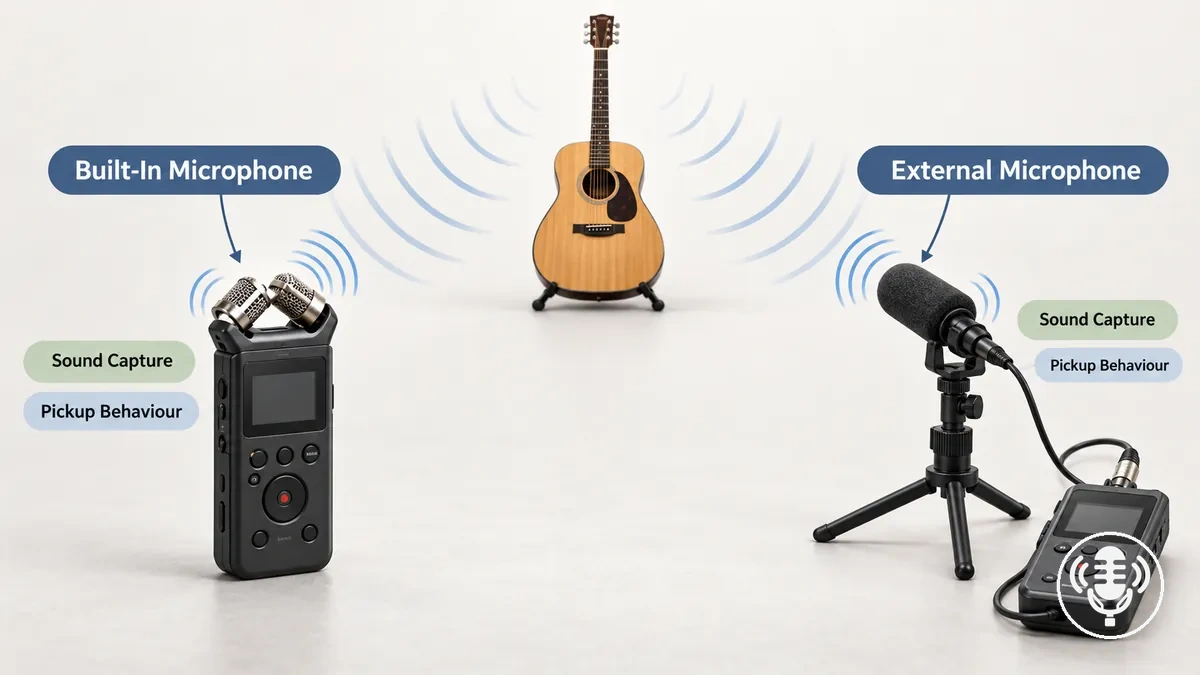
Built-in microphone
Provides capture at the recorder itself. The capture position therefore moves with the recorder.
External microphone
Places capture separately from the recorder, allowing the microphone position to be chosen independently while using a compatible signal path back to the recorder.
Practical interpretation
Under the same recording conditions, microphone position and pickup behaviour change the balance between the intended source and sound arriving from other directions.
These attributes explain the microphone's structural role; choosing a specific microphone requires matching its capabilities to the recording requirement.
Field Recorders for Audio Recording
A field recorder is the recording hub: it receives a captured signal through an input, records that signal as audio, and writes the resulting audio to supported storage.
Recorders may also integrate capture through built-in microphones and may expose a monitoring output for headphones; which integrated functions are present depends on the recorder configuration.
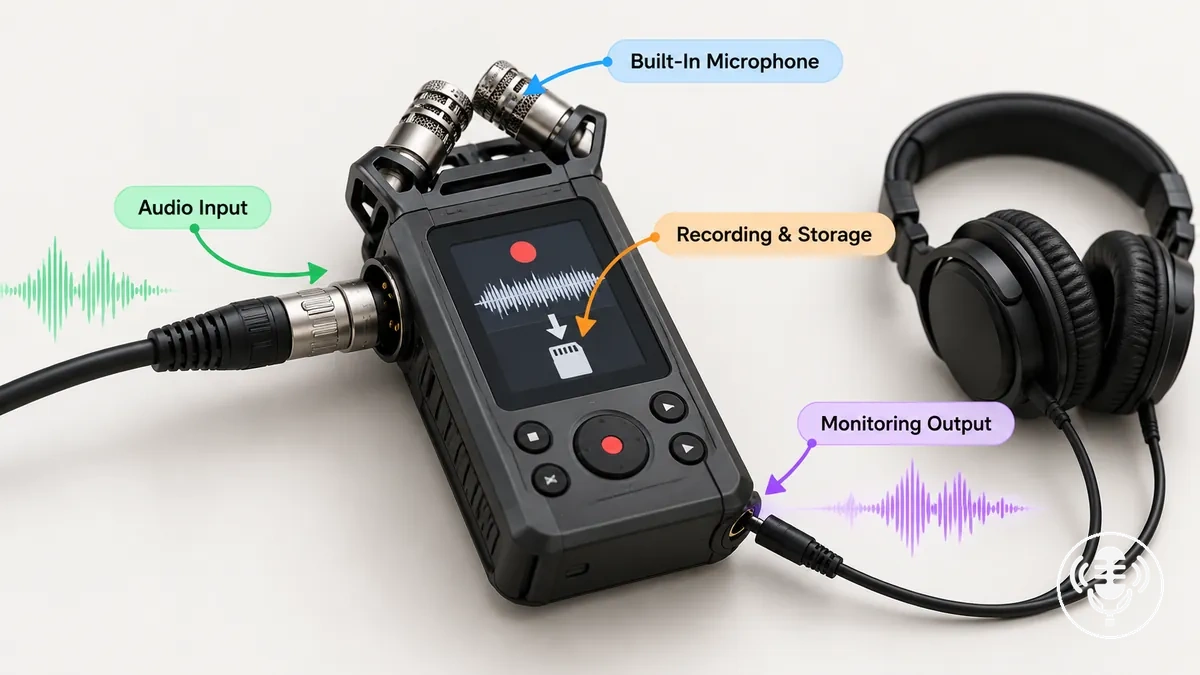
- Input
- Receives a signal from an external capture component when one is used.
- Recording
- Creates the recorded audio from the received or integrated capture signal.
- Storage
- Writes the audio file to storage supported by that recorder.
- Monitoring output
- When present, exposes recorder audio for checking through headphones or another compatible monitoring path.
Recorder selection is therefore a separate decision about which input, integrated-capture, storage, and monitoring capabilities the recording situation requires.
Headphones for Monitoring
Headphones are the monitoring component used to hear the recorder output during capture or checking.
What the operator can detect depends on what is present in that output, the surrounding field noise, and how effectively the headphones isolate the listening environment.
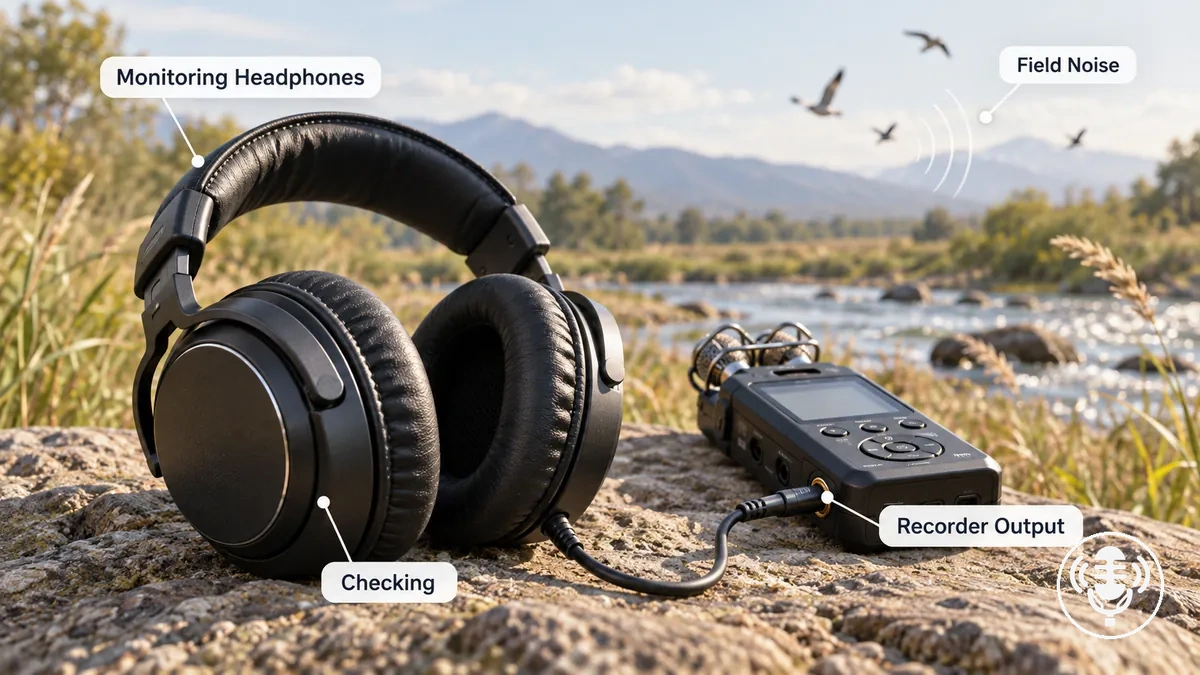
Monitoring can reveal
- Unwanted noise that is audible in the recorder output.
- Left-right balance differences that are audible under the listening conditions.
- Problems that become easier to hear when surrounding sound is sufficiently isolated.
Monitoring cannot establish by itself
- The root cause of every audible problem.
- That inaudible problems are absent under all later listening conditions.
- A guarantee of recording quality merely because the monitored signal sounds acceptable.
Headphones support monitoring and checking; they do not capture or store audio.
Supporting Components Beyond the Core Recording Path
Supporting components extend or protect the core recording chain when field conditions or equipment configuration create an additional requirement. They are selected by the function they need to serve, not from a universal accessory list.
The most useful question is therefore: what condition is present, and which supporting function answers it?
| Support category | Typical component | Condition that makes it relevant | Practical effect |
|---|---|---|---|
| Protection | Wind protection | Outdoor field conditions expose a microphone to moving air | Reduces direct airflow at the microphone, limiting wind-related interference with capture |
| Mounting | Stand or grip | A microphone or recorder requires controlled positioning or separation from direct handling | Supports positioning and can reduce direct handling of the equipment |
| Connection | Audio cable | Separate capture and recording components require a compatible signal connection | Provides a signal path between the connected components |
| Power | Battery or external power source | A field recorder or another powered component must operate for the planned session duration | Supplies operating power for the duration supported by the equipment and power source |
| Storage | Memory card | The recorder requires supported media with sufficient capacity for the planned recording | Provides storage for recorded audio within the recorder's supported media configuration |
| Transport | Bag or case | Equipment must be carried or protected between field locations | Organises equipment and provides carrying protection during field use |
Protection and mounting mainly answer environmental exposure, positioning, and handling needs; connection becomes necessary when separated components need a compatible signal path. Power and storage are capacity questions: the available power must cover the planned operating period, and the recorder must have supported storage with enough capacity for the intended recording.
For example, moving air around an exposed microphone can make wind protection relevant, while a compact integrated recorder may need transport protection but no separate cable or mount when those functions are not required by the setup.
Supporting components are condition-dependent: add the function when the recording situation creates the requirement, and omit the separate accessory when that function is already covered.
Essential Components and Condition-Dependent Accessories
A workable field recording setup must cover the functions the recording actually requires. Capture and recording are fundamental for acoustic recording to occur; monitoring and support functions become required when the environment, configuration, duration, or handling need creates that requirement.
A required function can be integrated into another component, so “essential” describes the function, not necessarily a separate physical item.
Function-by-function check
- Capture: Required for acoustic sound to enter the recording chain; it may be integrated when the field recorder has a built-in microphone or provided by a separate microphone.
- Recording: Required to create recorded audio; the field recorder provides this function and can also integrate other component roles.
- Monitoring: Required when the recording situation calls for the operator to hear the recorder output during capture or checking; otherwise it is optional as a separate function for making the recording, and monitoring capability may be integrated into the recorder.
- Protection: Condition-dependent; wind protection becomes relevant when moving air reaches an exposed microphone and interferes with capture, while it is optional when that field condition is absent.
- Power: Required for a powered component for the period it must operate; a separate power accessory is optional when the component's integrated power source covers the required session duration.
- Storage: Required when the recorder needs storage for recorded audio; the function may be integrated or provided by supported removable media according to recorder design and recording need.
- Mounting and positioning: Condition-dependent; a separate stand, grip, or other mounting component becomes relevant when the recording situation requires controlled positioning or separation from direct handling, and it is optional when those conditions are absent.
- Connection: Required when separate components need a signal path between them; a separate connection component is unnecessary when the relevant functions are integrated within one device.
- Transport: Condition-dependent; a bag or case becomes relevant when equipment needs carrying organisation or protection between field locations, while it remains optional for the recording function itself.
Compact integrated setup
A recorder with built-in microphones plus sufficient integrated power and storage can cover several required functions without separate capture, power, storage, mounting, or connection accessories when no independent positioning is needed.
Separated outdoor setup
A separately positioned microphone can create connection and mounting requirements; exposure to moving air can add wind protection, and a session longer than the available integrated power can add a separate power requirement.
The physical component list therefore changes with the environment, session duration, recorder design, and handling needs. Decide necessity from the recording situation rather than from a universal starter-kit formula.