
Portable Field Recording Equipment: Balancing Portability and Recording Capability
For portable field recording equipment, judge portability by the complete working setup—recorder, microphone arrangement, cables, power, support and carrying protection—not by recorder dimensions alone. Choose the smallest configuration that retains every capability the task requires; if required external gear increases packed footprint or setup effort, that burden is part of portability. Because recording requirements differ, there is no universal size or weight threshold that defines the best portable setup.
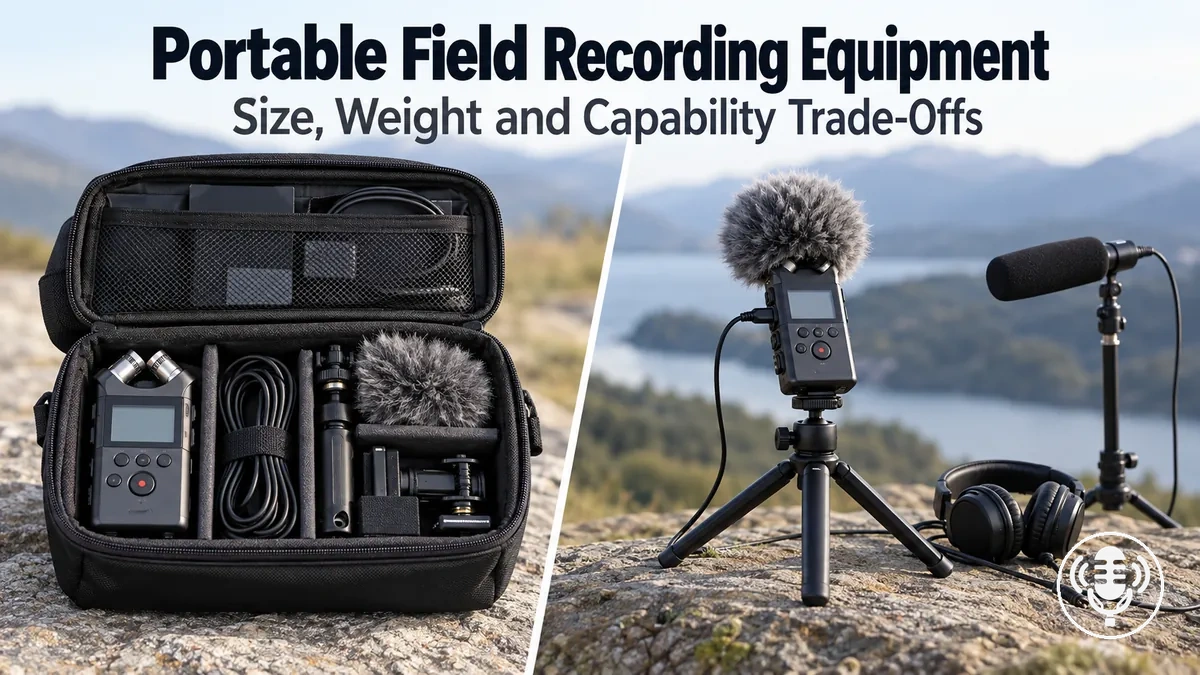
Find the smallest setup that still meets the recording job
Start with the recording requirement, then reduce size and carried hardware only after the required inputs, microphone arrangement, controls, monitoring, power and support are covered. These profiles are starting points; exact features remain model-specific.
Table of Contents
What Portability Means for Field Recording Equipment
Portability is a property of the complete usable recording setup: how easily it can be carried, accessed, deployed and operated while still providing the capability the recording task needs. Recorder dimensions and device weight matter, but they describe only the recorder itself.
There is no single size or weight threshold for portability because the required microphone arrangement, connections, power and support change the burden of the configured kit.
What to measure as portability
- Recorder-only size
- Body dimensions and device weight. Useful for comparing the recorder, but incomplete for the working kit.
- Complete-kit burden
- Total carried weight, packed footprint and the number of separate pieces required for the intended configuration.
- Deployment effort
- The handling needed to retrieve, connect, position and operate the required equipment before recording can begin.
- Capability boundary
- The setup remains suitable only while it retains the inputs, microphone arrangement, control access, power and support required by the task.
The complete setup is therefore the useful boundary for judging what is practical to carry. The illustration below shows why recorder-only size and the footprint of the carried system are not the same measure.
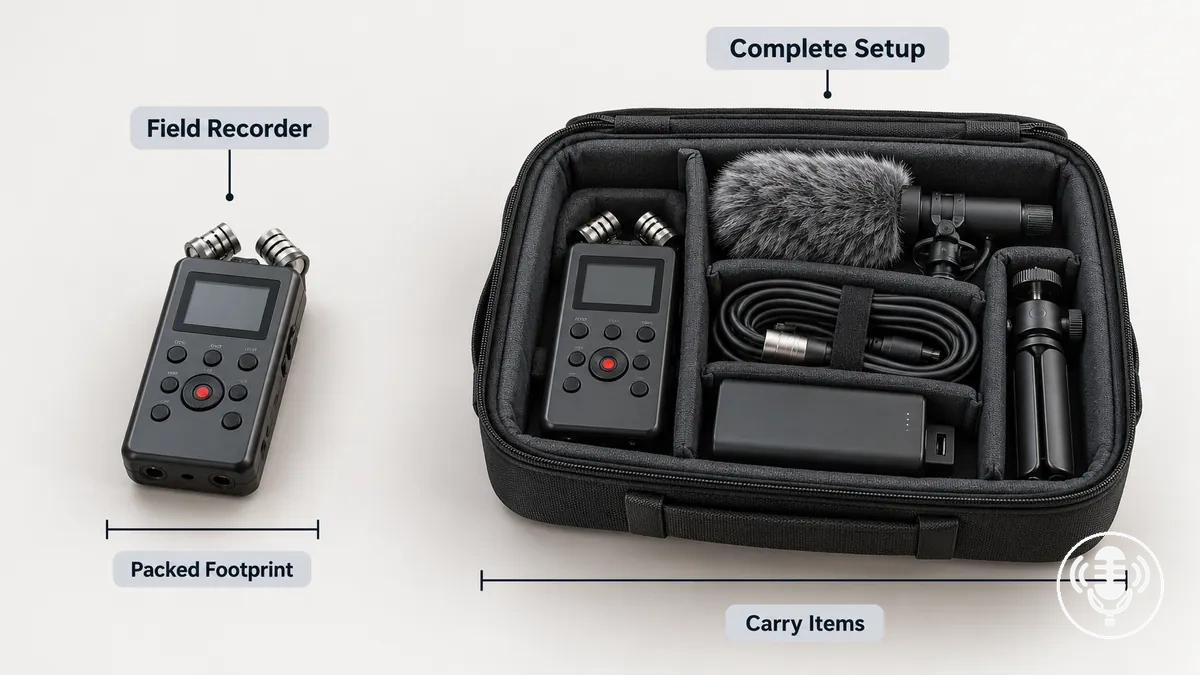
A small field recorder does not automatically make the whole kit equally compact. When the task adds a separate microphone, cables, power or support, those items increase the number of pieces, packed footprint and deployment burden.
Pocket, Compact and Full-Size Field Recorders: Portability Differences
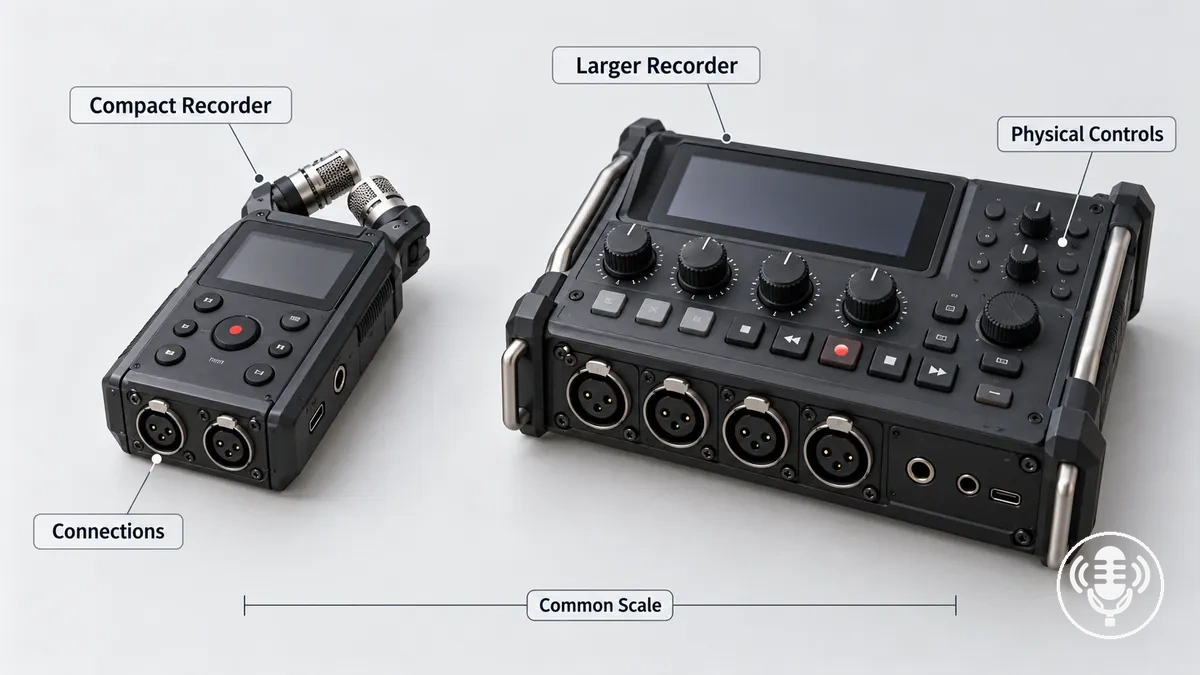
Pocket, compact and larger portable recorders describe physical carry forms, not standardised capability classes. A smaller body usually offers less surface area for connectors and dedicated controls, while a larger body offers more physical room for them; the actual inputs, channel count and control layout remain model-specific.
The useful comparison is the combination of carry form, connection access, physical controls, channel capacity and dependence on external gear—not a fixed dimensional boundary.

| Recorder size class | Carry form | Inputs and connections | Physical controls | External gear dependence | Portability effect |
|---|---|---|---|---|---|
| Pocket-size | Small body suited to minimal-space carry and quick access | Connection area is physically constrained; available input types and channels are design-specific | Limited surface area for dedicated controls; functions may share controls or menus | Lower when the required microphone and recording functions are integrated; greater when the task requires separate hardware | Reduces recorder footprint, but required external items can increase overall setup burden |
| Compact | Handheld carry with more body area than a pocket recorder | More physical space can accommodate additional connection access, although actual inputs and channels remain design-specific | More surface area can accommodate dedicated controls, depending on the control layout | Lower when required functions are integrated; greater when microphones or other required hardware are separate | Combines a manageable carry form with more physical space for controls and connections |
| Larger portable | Larger body requires more packing space while remaining intended for portable use | Greater enclosure area can accommodate a broader connection layout, while actual input and channel capacity remains design-specific | More surface area can accommodate greater physical control access, depending on the layout | Lower when the required recording configuration is self-contained; greater when separate microphones, power or other hardware are required | Increases recorder footprint while providing more physical space for connection and control access |
A pocket-size or compact recorder can be the more portable choice when its integrated functions meet the task. If the recording requires external microphones, cables or other hardware, the complete setup can lose part of that carry advantage even though the recorder itself remains small.
A larger recorder occupies more packing space, but its additional surface area can support more direct access to controls and connection areas. Size is therefore a physical tendency, not a quality ranking: smaller does not inherently mean worse sound, and larger does not automatically mean better suitability.
Total Carry Weight and Packed Footprint of the Complete Setup
Total carry weight and packed footprint should be calculated for the complete setup, not from the recorder specification alone. The exact result is configuration-specific, so no universal kit weight or pack-size threshold should be assumed.
Complete-kit accounting
Recorder, microphone arrangement, cables, batteries or external power, support gear and protective carrying items all belong in the portability calculation when the setup requires them.
The combined weight of the items needed for the intended configuration. Recorder weight alone is only the device-level contribution.
The space occupied by those same items when carried. It changes when the microphone, power, support or protection arrangement changes.
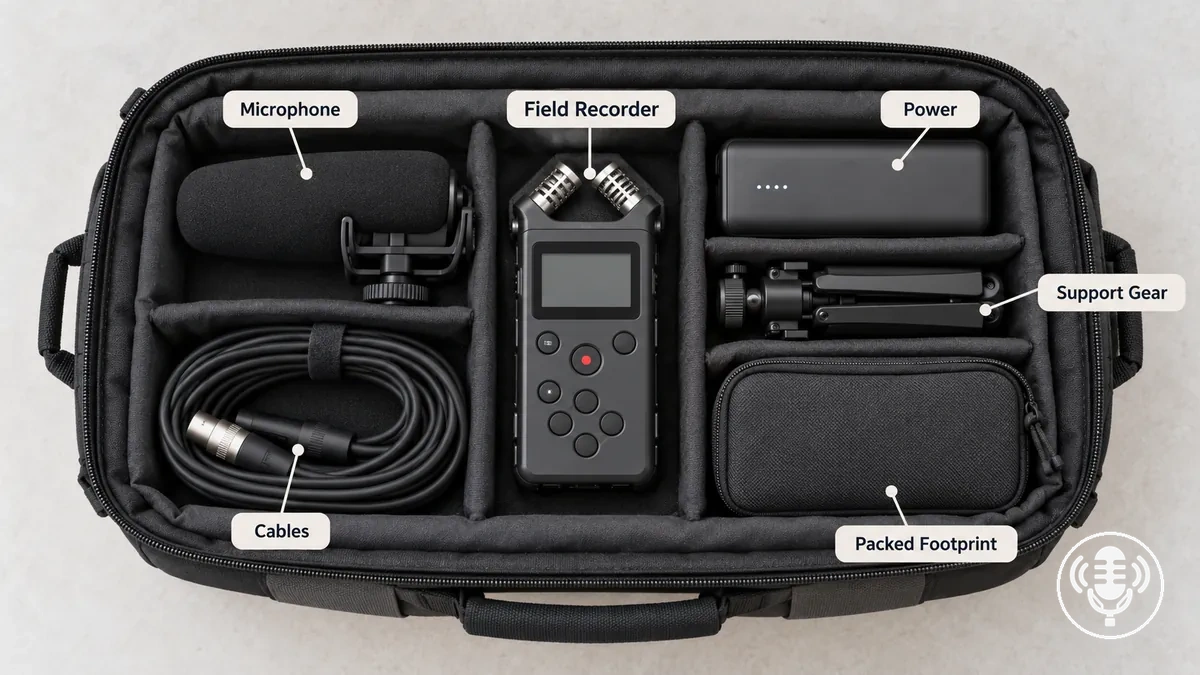
| Setup element | Weight or volume contribution | Packing condition | Portability effect |
|---|---|---|---|
| Field recorder | Contributes its device weight and body volume | Present as the central recording device in the complete setup | Establishes the recorder-only portion of the carried load and packed footprint |
| Microphone arrangement | Adds weight and volume when a separate microphone or microphone assembly is required | Contributes separately when the required recording arrangement uses a microphone outside the recorder body | Increases total carry weight, packed footprint and the number of separate items to deploy |
| Cables | Add weight and occupy packing space according to the connections required by the configuration | Contribute when external microphones, power or other required connections use separate cables | Increase accessory load and add items that must be packed and managed during setup |
| Batteries or external power | Add carried weight and packing volume beyond the recorder body | Contribution is set by the type and quantity of power items carried for the intended recording period | Increases total load and occupies additional packing space |
| Compact support | Adds weight and physical volume when a stand, mount or similar support is required | Contributes when the intended microphone or recorder position requires separate support gear | Increases pack size and adds another item to deploy |
| Protective carrying items | Add weight and occupy space around equipment carried in a pouch, case or similar protection | Contribute when carrying protection forms part of the intended configuration | Increases packed footprint beyond the dimensions of the recording devices themselves |
For example, using an integrated microphone arrangement can involve fewer separate carried items than configuring the same recorder with an external microphone, cable and compact support. Changing the configuration therefore changes both the total load and the space the kit occupies.
Include batteries or external power whenever they form part of the intended setup. Their exact contribution depends on the specific power items and quantity carried; detailed runtime planning is a separate selection question.
Recording Capability Trade-Offs as Equipment Gets Smaller
Recording capability can change as a field recorder becomes smaller because the enclosure provides less physical room for connectors and dedicated controls, but size alone does not determine sound quality or suitability.
For this comparison, recording capability means the functions and interfaces needed to complete the intended configuration: input and channel capacity, control access, microphone support, monitoring, synchronisation and the associated power arrangement.
Integrated microphones can reduce dependence on a separate microphone for suitable tasks. When the task requires an external microphone or another external function, the required connection, cable, mount, power or companion device becomes part of the portability trade-off.
| Capability dimension | What may change in smaller designs | What may require more hardware | Selection implication |
|---|---|---|---|
| Inputs and channels | When enclosure area limits connector placement, a smaller design may provide fewer physical connections; the actual input types and channel count remain model-specific | When the required sources exceed the recorder's available connection or channel capacity, the configuration requires another suitable recording or connection arrangement | Match available input types and channel capacity to the number and type of sources required rather than selecting by body size alone |
| Physical controls | When surface area is limited, a smaller design may provide less space for separate dedicated controls; the actual control layout remains model-specific | When required functions are not directly accessible on the recorder surface, operation relies on the control method provided by that model or configuration | Choose the control layout according to the direct access the recording task requires during operation |
| External microphone support | When a compact design includes integrated microphones, it may reduce the hardware needed for suitable tasks; external microphone support and connector type remain model-specific | When the recording requirement calls for an external microphone, the microphone and any required cable, mount or compatible connection become part of the setup | Evaluate whether the required microphone arrangement is self-contained or increases carried hardware and setup burden |
| Monitoring | When monitoring connections or dedicated controls are constrained by the design, access may differ between models rather than following recorder size alone | When the required monitoring method uses equipment outside the recorder, that equipment becomes part of the carried configuration | Confirm that the recorder and complete setup provide the monitoring method required during the intended recording task |
| synchronisation | When synchronisation is required, support must be checked at model level because enclosure size alone does not establish whether the function is available | When the recorder does not provide the synchronisation method required by the workflow, the configuration requires another suitable synchronisation method or device | Treat synchronisation as a workflow-specific capability rather than a consequence of compact or larger recorder size |
| Noise performance | When recording quiet sources or using substantial gain, self-noise becomes more consequential; its level depends on recorder and microphone design, configuration and recording conditions rather than physical size alone | When the recording condition requires a different microphone or signal arrangement to meet the task, that arrangement can add external hardware to the portable setup | Assess noise performance for the intended microphone arrangement and recording condition instead of using recorder size as a quality indicator |
| Power demands | When functions or connected equipment increase power requirements, the power burden can rise; the actual demand depends on recorder design, enabled functions and configuration rather than physical size alone | When the intended configuration requires additional batteries or external power, those items increase the hardware carried with the recorder | Match the power arrangement to the recording duration and required functions, then account for any resulting increase in carry burden |
For a workflow that needs an external microphone, direct monitoring or synchronisation with other equipment, verify those functions at the specific recorder and configuration level. A compact design that supplies them directly can keep the kit simple; missing functions can shift capability into separate hardware and increase carry burden.
Noise performance and power demand are also design- and configuration-specific. Quiet-source recording can make self-noise more important, while enabled functions or connected equipment can increase power demand; neither attribute should be inferred from body size alone.
The practical trade-off is therefore between required recording capability and the hardware needed to provide it. Smaller equipment is not inherently worse, and a larger recorder is not inherently more professional.
Carryability and Mobility in Practical Field Use
Carryability and mobility describe how easily the complete setup can be carried, accessed, operated, positioned and moved during the intended recording task. A travel-friendly kit therefore has to work both in transport and once recording begins.
Practical carryability is an operational criterion rather than a device-weight figure. The strongest signals are accessible storage, controlled loose components and cables, appropriate support, and the ability to move without repeatedly rebuilding the setup.
Mobility checklist
- Pocket or bag access: the portable field recorder has a defined accessible position in a pocket, pouch or bag when the recording task requires frequent retrieval.
- One-handed operation: the required controls can be reached with one hand when handheld operation is relevant to the task; otherwise the setup provides a stable operating position.
- Loose components: microphones, adapters, power items and other required pieces are organised so the recording task does not depend on repeatedly locating and assembling scattered items.
- Cable management: cables follow a controlled path appropriate to the required connections, reducing the number of loose elements that must be managed during movement.
- Support gear: a stand, mount or other support forms part of the mobile setup when the intended recorder or microphone position requires it.
- Setup friction: required components can move from their carried state to the intended recording arrangement without repeatedly reorganising unrelated equipment.
- Pack-down friction: the recording configuration can return to its carried state with required components, cables and support gear organised for the next movement.
- Movement between recordings: connections and support arrangements that can remain assembled for the intended recording behaviour reduce the amount of rebuilding required between positions.
A workable configuration gives every required item a defined carrying position and limits repeated assembly, disassembly and reorganisation between recordings. Setup and pack-down friction rise as more parts must be found, connected, positioned and reorganised.
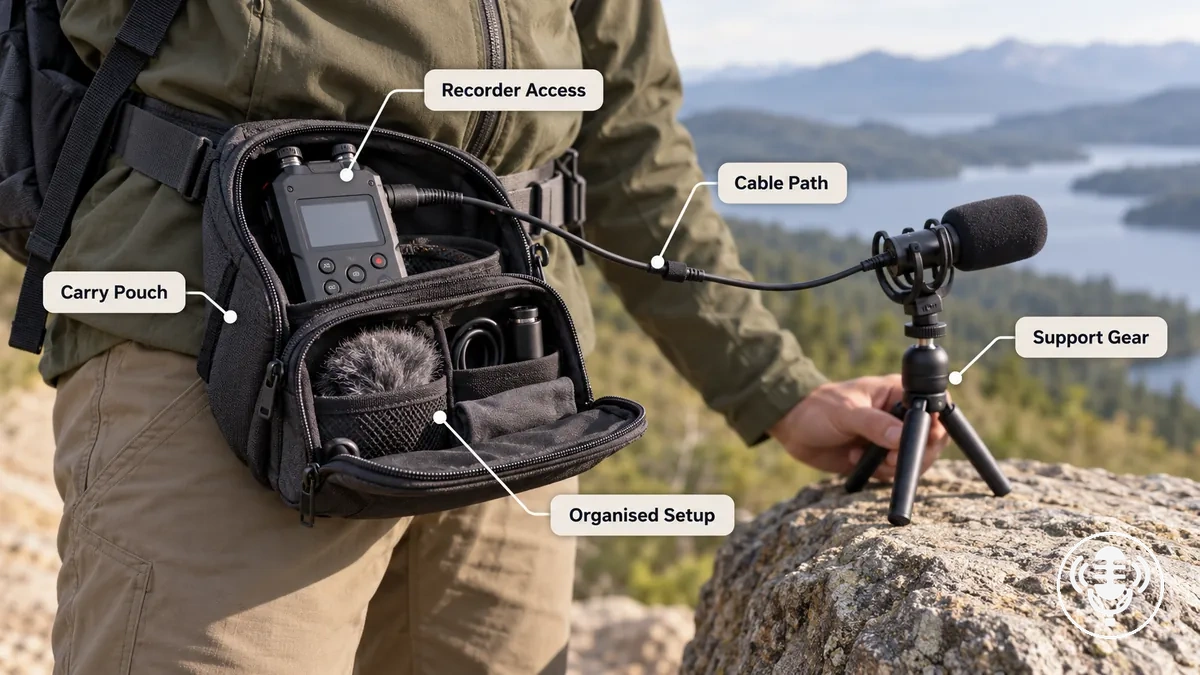
A portable setup supports practical mobility when its access method, operating position and pack-down arrangement match the recording behaviour. Weather exposure, ruggedness and broader outdoor-equipment protection are separate selection concerns rather than portability measures by themselves.
Choosing the Right Portability Level for the Capability You Need
Choose the portability level by defining the recording requirement first, then retaining every required capability before reducing size, carried weight or setup burden. The smallest suitable setup is the one that still performs the required recording job.
A compact or lightweight configuration is suitable only when it still provides the required inputs and channels, microphone arrangement, controls, monitoring, power and support. The acceptable carry burden comes from the real travel and operating conditions, not from a universal weight or size threshold.
Use hard requirements before convenience preferences
- Required inputs and channels: retain the input types and channel capacity needed for the sources in the recording requirement; capacity beyond what the task requires is optional headroom.
- Microphone dependence: include the microphone, connections and related hardware required by the intended recording arrangement; an integrated arrangement reduces this burden only when it satisfies the task.
- Control access: retain the controls needed during recording, with direct physical access treated as a hard requirement only when the operating behaviour calls for it.
- Monitoring: retain the monitoring method required for the task; monitoring hardware outside the recorder becomes part of the carried system when the configuration requires it.
- Power burden: include the power arrangement required for the intended recording period and functions, with any necessary batteries or external power counted as part of the setup burden.
- Support gear: include stands, mounts or other support when the required recorder or microphone position depends on them; otherwise they remain optional carry burden.
- Carry constraint: set the maximum acceptable size, carry weight and setup burden from the actual travel and operating conditions rather than from a universal threshold.
Inputs and channel capacity, microphone support, essential controls, monitoring, power and support gear are non-negotiable when the task depends on them.
Smaller dimensions, fewer carried pieces and lower weight are preferences when changing them does not prevent the required recording configuration.
Reduce size, weight or separate components only after the hard requirements are satisfied. Capability beyond the task is optional headroom; capability the task needs is the minimum boundary.
Pocket-Size Equipment for Everyday Carry and Spontaneous Recording
A pocket-size recorder suits everyday carry and spontaneous recording when quick access and minimum carry burden matter more than expanded connection or control capacity.
- Best fit when
- The routine task can be completed with an integrated or otherwise minimal microphone arrangement and few separate accessories.
- Practical boundary
- The complete required setup—not only the recorder—must fit the intended carrying position while retaining the necessary connections, controls, power and support.
- Less suitable when
- An external microphone, adaptor, separate power item or support gear is routinely required and removes the practical pocket-size advantage.
A pocket recorder works well for spontaneous recording when it can move from everyday carry to the required recording state with its essential microphone arrangement, controls and power already available.
Lightweight Modular Setups for Travel and Flexible Recording
A lightweight modular setup is preferable when a compact field recorder needs selected external capability and the resulting increase in packed size and setup effort remains acceptable for the intended travel conditions.
- Best fit when
- An external microphone or other selected module provides capability the task needs without turning the kit into an unnecessarily complex system.
- Portability cost
- Cables, power requirements and any compact support become part of the carried weight, packed footprint and deployment effort.
- Practical boundary
- There is no universal weight ceiling; the setup remains lightweight only while the complete kit stays within the user's actual carry and setup constraints.
For example, pairing a compact recorder with a required external microphone may also require cables and, depending on the configuration, separate power or support. That added burden is justified only when each added component solves a recording requirement.
Larger Portable Setups When Capability Outweighs Minimum Carry Size
A larger portable setup is justified when a required recording capability cannot be provided adequately by the smaller configuration being considered.
- Best fit when
- The workflow needs connection or channel capacity, XLR access, physical controls, monitoring, synchronisation support, backup recording or another capability that the smaller configuration does not provide.
- Portability cost
- A larger recorder and any associated power or support increase the carried and packed burden.
- Decision boundary
- Accept the extra bulk only when the capability enables the required recording configuration or operation; unused headroom adds burden without improving fit for that task.
A task involving multiple connected sources may justify the larger profile when the smaller setup lacks the required inputs, channels or connections. The same rule applies to monitoring, synchronisation, backup functions, power and support: include them because the workflow needs them, not because a larger system appears more capable.