
Field Recording Equipment Setup Configurations Compared
Choose a field recording setup by matching microphone integration, simultaneous channel count, spatial format, and setup complexity to the capture task. An integrated handheld suits fast, compact capture when its built-in microphones and channels are sufficient; a modular setup suits external microphone choice or expansion, while two-channel versus multichannel capacity follows simultaneous-source needs and mono versus stereo follows whether left-right spatial information must be retained.
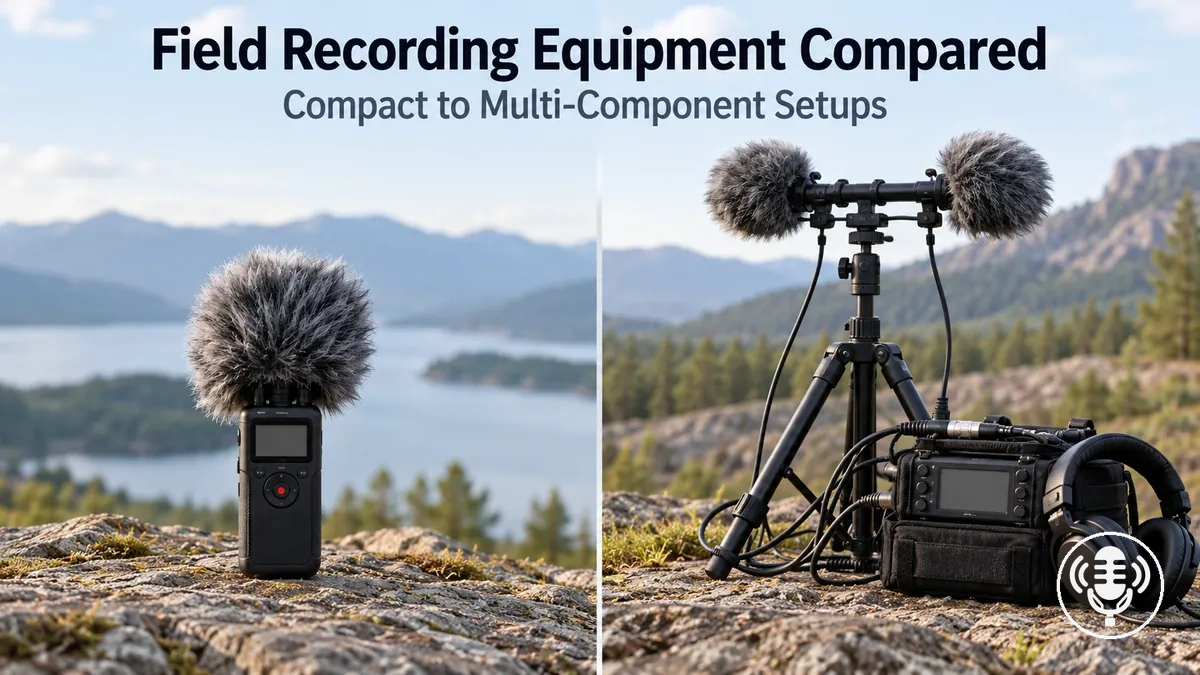
Setup configuration decision matrix
Use these four checks together. They describe different attributes of the same setup, so a configuration can be modular and stereo, or integrated and two-channel, rather than belonging to only one category.
- Microphone integration
- Integrated handheld: choose the built-in microphone path when it already suits the source and rapid, compact capture is the priority.
- Modular: use a separate microphone path when microphone type, placement, connection requirements, or future input expansion matter.
- Simultaneous channel requirement
- Two-channel: sufficient when the recording plan needs no more than two independent simultaneous paths.
- Multichannel: justified when more simultaneous independent paths are required or additional channel headroom serves a planned expansion.
- Spatial format
- Mono: use one recorded channel when left-right spatial information is not part of the intended result.
- Stereo: use two related channels when the microphone arrangement needs to retain left-right spatial differences.
- Operational trade-off
- Prioritise portability: favour fewer separate components, fewer connections, and only the channel capacity the task requires.
- Prioritise flexibility: accept additional cabling, monitoring, and control only when extra microphone paths or channels create a real recording benefit.
Decision rule: choose the simplest configuration that fully covers the required microphone paths, simultaneous channels, and spatial capture; extra capacity is useful when it supports a defined requirement, not merely because it is available.
Table of Contents
What Defines a Field Recording Setup Configuration?
A field recording setup configuration is the arrangement of the recorder, microphone path, channel structure, and supporting connections used to capture sound for a particular recording requirement. It describes how those parts work together, not simply which pieces of equipment are present.
Configuration at a glance
- Recorder integration
- The primary microphone path is either built into the recorder or connected as a separate external path.
- Microphone path
- The path defines how a captured signal reaches a compatible recorder input and then a recorded channel.
- Channel structure
- Channel capacity determines how many independent signal paths can be recorded simultaneously and how they are organised.
- Supporting connections
- External microphones can add cables, input compatibility, and power requirements; those additions increase setup work when they are needed.
These attributes affect portability, connection complexity, channel organisation, and expansion potential. Integration can reduce the physical footprint, while separate components can provide more microphone or input options when the recorder supports them; no single attribute makes a setup universally preferable.

For example, two setups can contain the same broad component categories—a recorder and microphone source—yet form different configurations when one uses an integrated path and the other routes an external microphone through separate connections and channels.
Configuration therefore describes the working relationship among components, establishing the basis for comparing integrated and modular paths, channel capacity, and mono or stereo capture.
Integrated Handheld vs Modular Field Recording Setups
An integrated handheld setup and a modular field recording setup differ mainly in where the microphone path sits in the recording chain. Used as an integrated setup, a handheld recorder relies on its built-in microphones; a modular setup uses one or more separate microphones connected to recorder inputs.
The central trade-off is fewer separate components and faster deployment versus greater microphone choice, placement flexibility, and potential expansion. The better arrangement is the one whose microphone path, inputs, and channels match the recording task.
| Setup type | Microphone integration | Connections and setup effort | Channel and expansion flexibility | Practical trade-off |
|---|---|---|---|---|
| Integrated handheld | The recorder's built-in microphones form the primary capture path; some handheld recorders may also provide external inputs. | Using the built-in path means fewer separate microphone components and external connections to position before recording. | Available channels, built-in microphone options, and any external-input expansion are bounded by the recorder's design. | Supports compact, rapid capture when the built-in microphone arrangement meets the task, with less independent microphone placement than a separate-microphone setup. |
| Modular setup | One or more external microphone paths connect separately to compatible recorder inputs. | Separate microphones, cables, and required power or connection arrangements add setup and handling steps. | Microphone choice and expansion can increase when the recorder provides the required inputs and recording channels. | Provides greater microphone placement and configuration flexibility, with more connection management as the signal chain expands. |
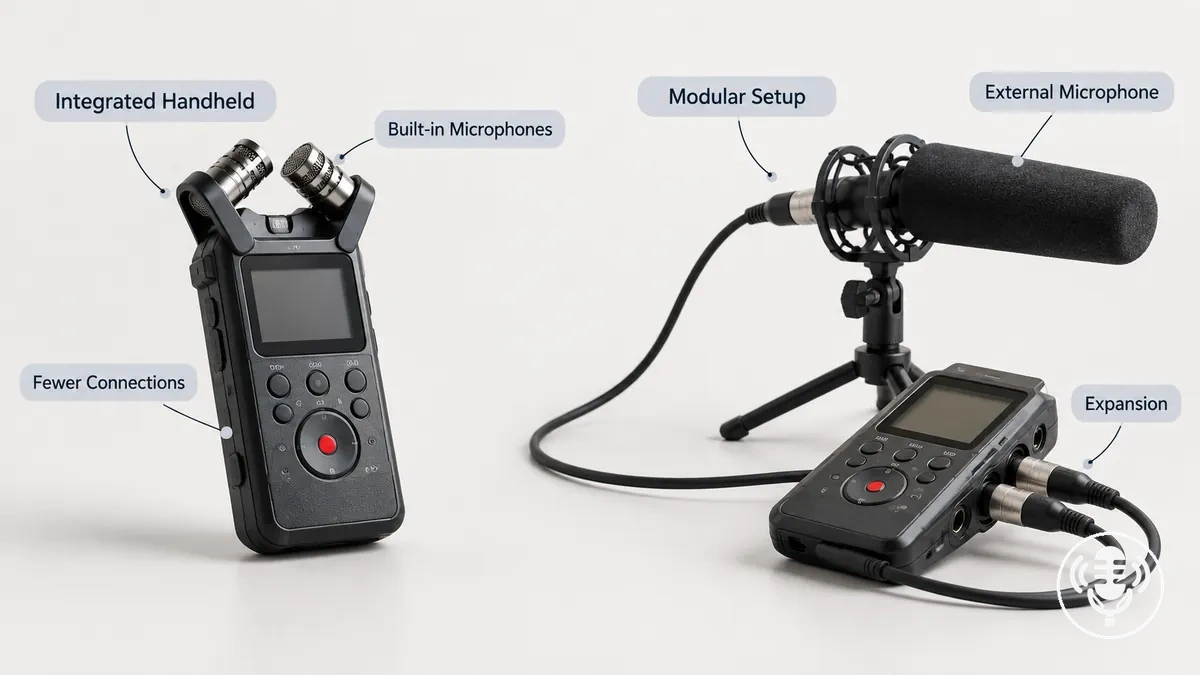
A handheld recorder can also participate in a modular signal chain when external inputs are used, so the distinction is about the capture arrangement, not only the physical shape of the recorder.
Self-Contained Recorder Signal Chains
A self-contained recorder signal chain uses the recorder's built-in microphones as the primary source and routes them through the recorder's internal input and recording stages to the recorded channels.
Because the microphone and recorder share one body, fewer external signal connections are required. This can reduce setup effort and support rapid deployment, while the microphone position and orientation remain tied more closely to the recorder body than with separate microphones.
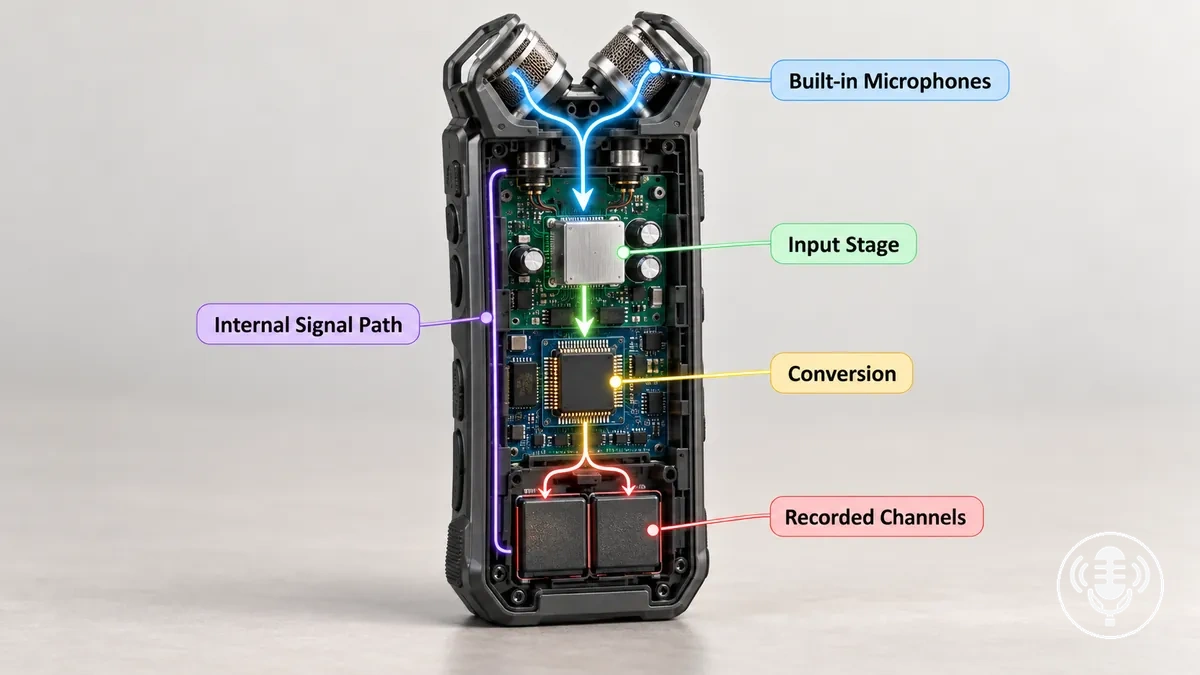
This configuration is a good fit when the built-in microphone arrangement, available recorded channels, and monitoring controls already meet the capture requirement.
Its practical limits are set by the recorder's own design, including its built-in microphone geometry, channel capacity, monitoring options, and any external inputs it provides.
Separate Microphone and Recorder Signal Chains
A separate microphone and recorder signal chain routes an external microphone through its required connection to a compatible recorder input and then through the recorder to a recorded channel.
Capture and recording functions are therefore distributed across separate components, with the microphone connection and recorder input forming the bridge between them.
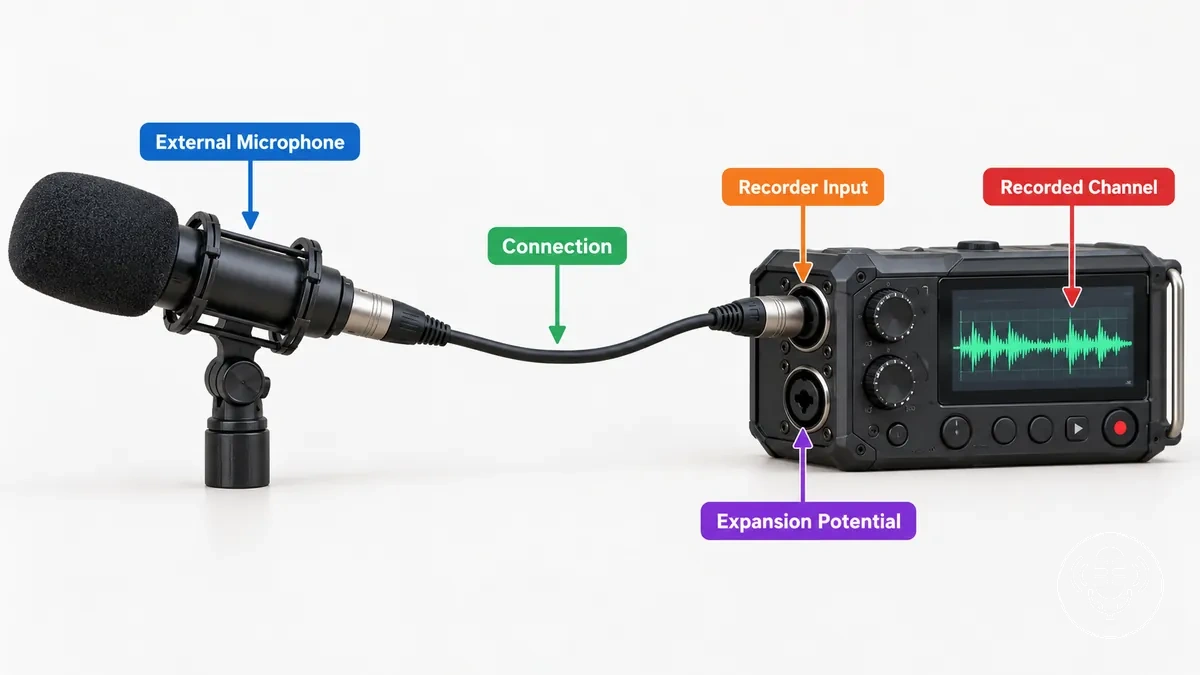
Before recording, match the connector and signal type, input level, and any required microphone power. Power is not one universal value: depending on microphone design, the path may require phantom power, plug-in power, battery power, or no power supplied by the recorder.
Each independently recorded signal path needs a usable recorder input and recording channel, so expansion is bounded by the recorder's input and channel capacity. Additional paths also add cables, monitoring, and connection management.
The modular signal chain is therefore most useful when its added microphone choice or placement flexibility solves a real capture requirement and the recorder supports the necessary inputs.
Compact Two-Channel vs Multichannel Recording Setups
A compact two-channel setup suits recording requirements that fit within two simultaneous independent paths, while a multichannel setup provides additional input and recording capacity for several simultaneous sources or planned expansion.
The trade-off is straightforward: more simultaneous-path capacity can solve a larger recording requirement, but it also increases the potential connection burden, cabling, monitoring, and control work.
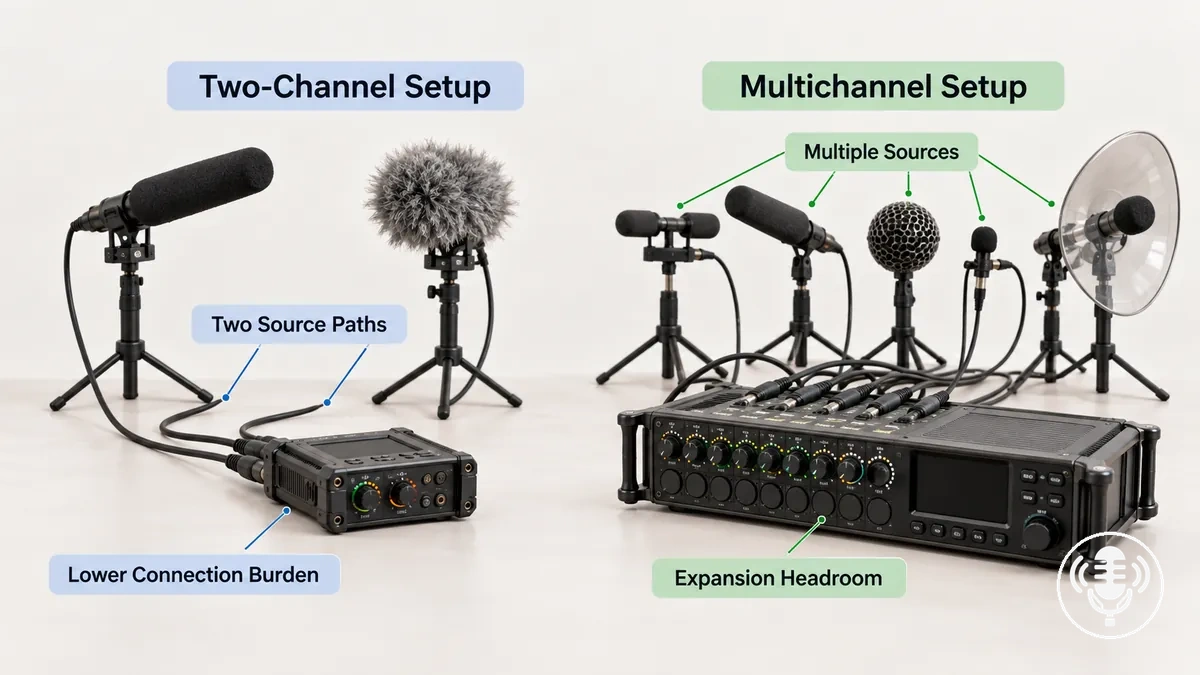
Count the sources that need independent recording paths at the same time, not the total number of sources that may appear across an entire session. If that simultaneous requirement fits within two paths, extra channels are not necessary for capacity alone.
| Configuration | Simultaneous-source capacity | Connection burden | Control demands | Expansion headroom | Practical fit |
|---|---|---|---|---|---|
| Compact two-channel | Fits a recording requirement that uses no more than two independent simultaneous channel paths. | Up to two active source paths keep the number of simultaneous connections and associated cabling bounded. | Monitoring and control remain focused on the two available recording paths. | Additional simultaneous sources require capacity beyond the two-channel configuration. | Best matched to recording plans whose simultaneous-path requirement already fits within two channels. |
| Multichannel | Fits several simultaneous sources when the recorder provides enough independent inputs and recording channels for them. | More active paths introduce additional connections and cabling to arrange and manage. | Monitoring and control demands rise as more independent paths are active at the same time. | Unused channels can provide useful headroom only when additional simultaneous paths are reasonably planned. | Best matched to sessions that need more simultaneous independent paths or justified expansion capacity. |
Choose channel capacity from the simultaneous-source requirement. Use two-channel capacity when two independent paths are enough; move to multichannel capacity when more paths are required or when additional channels serve a defined expansion plan.
Mono vs Stereo Field Recording Configurations
Mono and stereo field recording configurations serve different capture goals, not a quality hierarchy. Mono represents the capture in one recorded channel, while stereo uses two related channels whose differences carry left-right spatial information.
A stereo result depends on the microphone arrangement creating meaningful differences between the left and right channels; simply duplicating the same mono signal into two channels does not create a spatial stereo image.
Mono or stereo: choose by the spatial information you need
Mono
- Recorded channels
- One channel.
- Best fit
- Focused sources when left-right position or width is not required in the intended result.
- Trade-off
- Simpler single-channel monitoring and editing, but no stereo left-right image is retained.
Stereo
- Recorded channels
- Two related channels.
- Best fit
- Ambience and scenes where the microphone arrangement should retain left-right spatial differences.
- Trade-off
- Preserves spatial information but requires two-channel capture plus appropriate microphone placement and monitoring.
Decision rule: use mono when the intended result does not need lateral spatial information; use stereo when left-right spatial relationships are part of what the recording must convey.
For a focused point source such as a single voice or isolated sound, mono can be sufficient when spatial direction is not part of the intended use. For ambience or a wider scene, stereo is useful when the recording needs to preserve spatial relationships across the sound field.
Field Recording Setup Trade-Offs: Portability, Channels, Expansion, and Control
A field recording setup configuration should balance portability, channel capacity, expansion potential, connection burden, and control against the actual recording requirement. Size and weight matter most when mobility matters; channels, connections, and control become more important as the number of simultaneous independent paths increases.
For rapid mobile capture, a compact configuration is advantageous when its microphone path and channel capacity already cover the task. For several simultaneous sources, additional inputs and control can be worth the greater cabling and monitoring load because those capabilities are then required rather than merely optional.
Selection criteria
- Portability and physical footprint: prioritise lower size and weight when frequent movement or rapid capture matters; a larger configuration becomes a constraint when its additional capacity is unnecessary.
- Simultaneous channel requirement: choose enough independent recording paths for the sources that must be captured at the same time; extra channels are valuable only when they serve a planned need.
- Connection burden: fewer connections favour rapid setup and simpler cable management, while additional connections are justified when required microphone paths depend on them.
- Expansion potential: prioritise expandability when additional simultaneous source paths are reasonably anticipated; otherwise unused expansion capability need not outweigh portability or simplicity.
- Control depth: deeper control is useful when several active paths need separate monitoring or adjustment, but it adds operational complexity when the task needs only a simpler control structure.
Choose the configuration whose capabilities match the recording plan rather than maximising any single attribute. Favour a smaller, simpler setup when it fully covers the task; accept greater size and operational complexity when extra microphone paths, simultaneous channels, or control depth are necessary.