
Field Recorder Selection for a Field Recording Setup
Choose a field recorder by matching it to the recording chain: it must provide enough usable simultaneous inputs, channels and recording tracks for the planned sources, the required connection and microphone-power support, and suitable preamp/gain performance for expected source levels. After those must-haves are met, prioritise recorder design, 32-bit float, field power, size and controls by workflow: handheld recorders suit self-contained capture, compact XLR designs suit portable external-microphone setups, and multichannel recorders suit several independently controlled sources.
Setup-fit decision assistant
Match recorder capability to your recording setup
Choose the conditions that describe your setup. The result identifies the recorder profile to investigate first and the requirements that remain non-negotiable.
Starting profile
Handheld / self-contained recorder
A compact recorder with built-in microphones is the natural first profile when integrated capture is central and several independently controlled external sources are not required.
- Confirm any planned add-on source fits the recorder's available inputs and usable channels.
- Match battery or external-power planning to the expected session and operating load.
- Treat portability and control layout as workflow preferences after compatibility is confirmed.
This assistant identifies a recorder profile, not a universal best model. Exact input counts, recording modes, power behaviour and implementation details must still be checked on the recorder being considered.
Use the assistant as a first filter, then compare specific recorders only after the setup's required signal path, simultaneous capacity and microphone-power conditions are satisfied.
Table of Contents
What a Field Recorder Contributes to a Field Recording Setup
A field recorder is the device that captures and stores audio within a field recording setup.

- Capture the sourceA microphone produces the signal, or the recorder uses its built-in microphone path for self-contained capture.
- Accept and route the signalThe recorder must provide a compatible input path and a usable recording channel for each source needed at the same time.
- Control the recordingGain, channel controls and monitoring are used as the recorder and workflow allow; microphone power is supplied only where the connected microphone requires it.
- Store the audioThe recorder writes the captured channels as audio files to its supported storage while the operator monitors the session where the model provides the required monitoring path.
The recorder is one part of the wider recording chain; the field recording equipment guide places recorder choice alongside microphones, connections and the rest of the setup.
Field Recorder Designs and the Setups They Suit
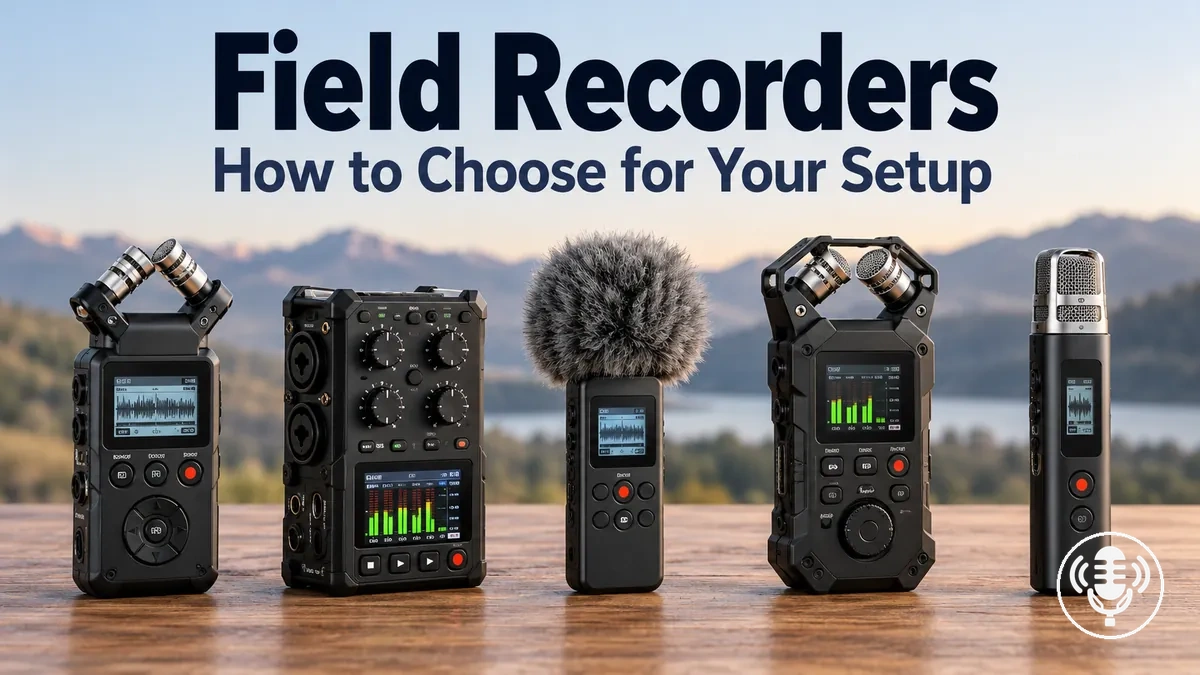
Field recorder designs suit different recording configurations because form factor, integrated capture, and input architecture determine how audio sources connect and how the recorder is carried and controlled.
A handheld recorder commonly combines built-in mics with a compact portable recorder form, a compact XLR design centres external-microphone connectivity, and a multichannel recorder provides an architecture for handling multiple connected sources and channel controls.
These are practical design groupings with possible overlap rather than mutually exclusive categories.
The comparison below maps integrated capture, input pattern, channels, portability, and setup fit.

| Recorder design | Integrated capture | Input pattern | Channel requirement | Portability trade-off | Setup fit |
|---|---|---|---|---|---|
| Handheld recorder | Built-in mics support self-contained capture; exact microphone arrangements depend on the recorder | Integrated capture is central; external inputs depend on the recorder configuration | Suited to compact source configurations when the available channels cover the planned sources | Compact form favours portability and fewer external components | Suits setups that prioritise self-contained capture and a minimal equipment footprint |
| Compact XLR recorder | External microphones form the main capture path; integrated microphones depend on the design | XLR inputs accept compatible external microphones; available input features depend on the recorder | Suited to configurations whose simultaneous sources fit within the available input and recording channels | Portable form is retained, but external microphones and connections add equipment to the setup | Suits portable setups built around external microphones and direct recorder inputs |
| Multichannel recorder | Capture is oriented toward multiple connected sources; integrated microphones depend on the design | Multiple external inputs and channel controls support expanded source configurations | Suited to configurations requiring more simultaneous source handling, subject to the recorder's available channels | Expanded input and control layouts can require a larger field setup than a compact recorder configuration | Suits configurations that need several sources managed and recorded through one field recorder |
For example, a compact setup centred on built-in mics can favour a handheld recorder because integrated capture reduces the need for separate microphones and connections, while a setup built around external microphones requires the appropriate XLR inputs and recording channels.
As simultaneous sources and required channel controls increase, a multichannel recorder can provide the corresponding input architecture, with portability then shaped by the recorder's physical design and the connected equipment.
Suitability therefore depends on the recording configuration: the source arrangement, required connections, simultaneous channel needs, and portability condition.
Handheld Recorders for Compact, Self-Contained Recording
A handheld recorder fits field recording that prioritises a compact, portable recorder with built-in mics and direct controls in one body.

Good fit when
Built-in microphones are the main capture path, a small equipment footprint matters, and any planned add-on sources fit the recorder's available inputs and usable channels.
Less suitable when
The setup needs more external microphones or simultaneous sources than the recorder can accept and record in the required mode.
Trade-off to judge
Portability versus expansion and control access: an integrated body reduces separate equipment, but the specific recorder's connections, channel capacity and control layout determine how far the setup can grow.
Compact XLR Recorders for External-Microphone Setups
A compact XLR field recorder fits a portable recorder setup built around an external microphone when its XLR input or XLR/TRS combo inputs accept the required connections and provide enough usable channels for the planned sources.

- Connection: the recorder must provide the XLR, XLR/TRS or other input mode required by the planned microphone or source.
- Simultaneous capacity: every source recorded at the same time needs a usable input, recording channel and track in the selected recording mode.
- Microphone power: phantom power is required only for a connected microphone that needs it, and the relevant recorder input must support that powering requirement.
- Control access: confirm that the channel, gain and monitoring controls needed during the recording are practical for the intended field workflow.
Match recorder-side XLR and microphone-power support to the microphone requirements described in the field recording microphones guide; the connector label alone does not establish compatibility.
Multichannel Recorders for Recording Several Sources at Once
A multichannel recorder becomes relevant when multiple sources must be recorded simultaneously and the portable recorder provides enough usable inputs, channels, and recording tracks for every source needed at the same time.

Added channels can also increase the monitoring and controls needed during recording, while physical size or power demands can increase depending on the portable recorder's design and operating configuration.
Field Recorder Criteria That Determine Suitability
A field recorder should first be judged against the non-negotiable requirements of the planned recording setup.
Inputs, channels, XLR connectivity, phantom power where required, preamp noise and gain demands, and sufficient field power can therefore exclude a recorder before convenience features are compared.
- Source and channel count: identify how many sources must be recorded simultaneously, then verify that the recorder provides enough usable inputs, channels, and recording tracks; insufficient simultaneous capacity excludes it.
- Input and connector needs: if the setup requires XLR connections or another specific input type, verify that the field recorder provides the required connection and input mode; a missing required connection makes the recorder unsuitable for that configuration.
- Microphone powering: if a connected microphone requires phantom power, verify that the required recorder inputs can supply it under the planned configuration; phantom power is not a requirement for microphones or devices that do not need it.
- Preamp noise and gain: for quiet sources or microphones that require more recorder gain, verify that the recorder's preamp noise and usable gain suit the planned signal path; capability that does not meet that requirement excludes the recorder for that setup.
- 32-bit float relevance: treat 32-bit float as a workflow requirement when the planned recording method relies on it to handle large or unpredictable level changes; otherwise, it remains an optional capability rather than a condition of recorder fit.
- Battery and power: match battery life and available power options to the required recording duration and operating configuration; a recorder that cannot cover the planned session with an acceptable power strategy fails that field-use requirement.
- Size and portability: match recorder size and carrying requirements to how the setup will be transported and operated; portability is a preference unless the field conditions impose a practical size or carrying constraint.
- Control access: verify that the controls needed during recording are accessible for the planned workflow; control convenience is negotiable unless the workflow requires direct adjustment or monitoring.
A failed must-have criterion removes a recorder from consideration. A preference changes how attractive the remaining compatible options are; it does not make an incompatible signal path workable.
Inputs, Channel Count, and Phantom Power Requirements
A field recorder is compatible with a planned source configuration only when its usable inputs, simultaneous channels, and microphone-power support meet the requirements of the sources being recorded.
An XLR or XLR/TRS connector provides a physical input path, but usable recording capacity can also depend on the recorder's recording mode and configuration.
Check source count, connector type, simultaneous channels, and whether each microphone requires phantom power before selecting the recorder.
| Recording source/configuration | Input requirement | Simultaneous channel condition | Phantom-power condition | Selection effect |
|---|---|---|---|---|
| Single microphone source | One compatible input, such as XLR or XLR/TRS when required by the microphone connection | The required input must be available as a usable recording channel in the selected recording mode | Required only when the connected microphone requires phantom power | Suitable when the recorder supports the required connection, recording channel, and microphone-power condition |
| Multiple microphone sources | A compatible input path for each source recorded at the same time | Usable simultaneous channels must cover all sources required for the multichannel recording configuration | Each input connected to a microphone requiring phantom power must support that powering requirement | Exclude the recorder when its usable simultaneous input or channel capacity cannot cover the planned sources |
| Mixed powered and unpowered microphone sources | Compatible XLR, XLR/TRS, or other required inputs for the planned source connections | The selected recording mode must provide simultaneous channels for every source needed at the same time | Phantom power is required only on input paths serving microphones that require it | Suitable only when connection, channel, and powering requirements can be met together in the planned configuration |
Physical connector count should not automatically be treated as usable simultaneous recording capacity because available channels can differ with the field recorder's recording mode and configuration.
Likewise, XLR connectivity does not by itself establish a phantom-power requirement; microphone power must match the requirement of the connected microphone.
If a required input type, usable simultaneous channel or required microphone-power condition is missing, the planned configuration is incompatible unless the setup changes.
Detailed connector, routing, and channel behaviour belongs to the dedicated inputs outputs and channels compatibility context.
Preamp Noise and Gain for Quiet or Low-Level Sources
Preamp noise and usable gain matter more when a field recorder must substantially amplify quiet or low-level sources.
A lower-output microphone or quieter source can require more gain, making noise added by the recorder more consequential relative to the wanted signal.
Recorder selection should therefore relate source level and microphone output to the required gain and the recorder's noise performance rather than treating maximum gain as a normal-use benchmark.
| Source condition | Gain demand | Recorder-noise concern | Useful evidence | Selection signal |
|---|---|---|---|---|
| Low-level source or lower-output microphone | More amplification is required to reach the intended recording level | Preamp noise becomes a greater selection concern because substantial amplification can make recorder-added hiss more consequential relative to the wanted signal | Usable gain range and comparable EIN or input-noise specifications where provided | Give greater weight to sufficient usable gain and lower preamp noise |
| Moderate-level source and microphone output | Less amplification is required than for a lower-level source under otherwise comparable conditions | Recorder-added hiss remains relevant, but its practical significance is shaped by the microphone output, required gain, and resulting noise floor | Usable gain and recorder-noise specifications measured under comparable conditions | Assess preamp noise alongside the other recorder requirements for the planned recording chain |
| Higher-level source or higher-output microphone | Less recorder amplification is required to reach the intended recording level | Preamp noise carries less selection weight when the required gain is lower and recorder-added noise is less consequential relative to the wanted signal | Usable gain range considered with microphone output and expected source level | Prioritise preamp-noise performance according to the actual gain demand rather than maximum-gain performance alone |
Recorder-added hiss is noise contributed by the recorder input path and is distinct from microphone self-noise and environmental noise.
EIN, or equivalent input noise, indicates input-referred noise and can inform recorder comparison when published figures use comparable measurement conditions; figures based on different source impedances or measurement methods should not be treated as directly equivalent.
Practical audibility depends on source level, microphone output, required gain, the resulting noise floor, and listening conditions.
Broader audio quality and noise performance should therefore be assessed separately from this recorder-preamp selection variable.
32-Bit Float Recording and Gain-Management Trade-Offs
32-bit float recording can make large or unpredictable level changes easier to manage when a field recorder and the subsequent workflow support the recording format.
Compared with conventional fixed-point capture, it provides greater level-handling flexibility for gain management and can allow post-recording level adjustment within the limits of the recorder's implementation and signal chain.
This benefit is strongest when source levels or unexpected spikes vary substantially during a recording.
| 32-bit float can help with | 32-bit float does not by itself guarantee |
|---|---|
| Managing unexpected level changes with greater level-handling flexibility when the recorder's implementation supports the required dynamic range | Protection from clipping or overload at every point in the microphone and recorder signal chain |
| Post-recording level adjustment when the recording format and software compatibility support the 32-bit float workflow | Recovery from microphone overload, unsuitable microphone placement, or other upstream problems outside the recoverable recording stage |
| Preserving greater level-handling flexibility than conventional fixed-point capture in a supported workflow | Lower microphone self-noise, lower recorder preamp noise, or a lower overall noise floor |
| Reducing the practical pressure of gain management when sudden level variation is difficult to predict | Suitable microphone choice, recording technique, or appropriate monitoring and setup decisions |
32-bit float is a gain-management advantage, not a guarantee against clipping, noise or poor recording technique throughout the signal chain.
The term 32-bit float specifically describes floating-point representation and should not be treated as interchangeable with generic 32-bit recording.
Its practical value depends on the field recorder's implementation, where overload can occur in the signal chain, the dynamic range required by the source, and software compatibility with the recording format.
A field recorder with 32-bit float should therefore receive greater selection weight when unpredictable level changes materially affect the intended workflow, while the feature can remain secondary when those conditions do not apply.
Battery Life, Size, and Controls for Field Operation
Practical battery life and field usability vary with the field recorder, battery type or other power source, enabled features, powered microphones, and operating load.
- Runtime requirement
- Power must cover the expected session duration under the planned operating load, with a practical reserve or supported backup strategy where the session cannot be interrupted.
- Operating load
- Active channels, phantom-powered microphones and enabled recorder functions can increase power demand, so headline runtime is not a universal field value.
- Recorder size
- A smaller body can reduce carrying burden, but dense controls may make frequent adjustments less convenient.
- Control access
- Direct, readable controls matter more when gain, routing or monitoring must be adjusted repeatedly during the session.
Field-use rule: plan power for the actual session and configuration rather than a fixed runtime claim, then judge size and control access together against how the recorder will be carried and operated.
Prioritising Field Recorder Trade-Offs for the Intended Setup
Select a field recorder by eliminating candidates that fail the intended setup's non-negotiable requirements before comparing preferences.
Required inputs, channels, microphone-power compatibility, and suitable preamp noise and gain for the expected source levels determine whether a candidate remains viable.
- Define simultaneous source and channel requirements: identify the sources that must be recorded at the same time and keep only candidates with enough usable inputs, channels, and recording capacity for that configuration; exclude a recorder when its simultaneous capacity cannot cover the planned sources.
- Verify input and powering compatibility: match the required input types to the planned microphones or other sources and verify phantom power where a connected microphone requires it; exclude candidates that cannot provide a required connection or powering condition.
- Check gain and noise performance: relate microphone output and expected source level to the required gain and preamp noise performance; for quiet or low-level sources, exclude a recorder when its usable gain or recorder-noise performance does not suit the intended signal path.
- Decide which workflow conditions materially matter: give 32-bit float greater priority when unpredictable level changes make its gain-management workflow useful, and assess battery life, size, portability, and controls against the expected session duration and field operation; prioritise each attribute only when the intended setup materially relies on it.
- Compare the acceptable trade-offs: after every must-have condition is satisfied, rank the remaining candidates by the priorities that matter to the intended setup and remove any option whose compromises in battery life, portability, controls, or workflow are unacceptable.
Example
If two recorders both satisfy the required inputs, channels, microphone-power compatibility, gain and preamp-noise conditions, one may favour smaller size while the other favours direct controls or a 32-bit-float workflow. Because both remain viable, the better choice is the one whose remaining trade-offs best fit the intended field use.
The strongest fit is the field recorder that satisfies every required condition while imposing the fewest unacceptable trade-offs for the intended setup.