
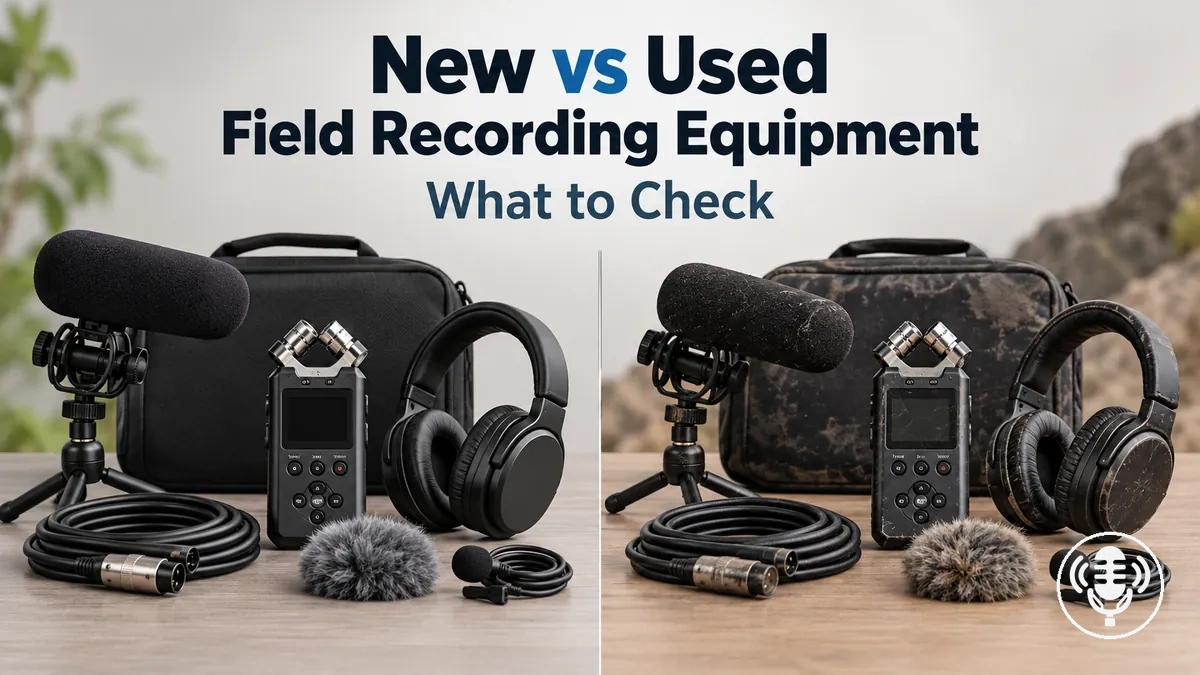
New vs Used Field Recording Equipment Compared
Choose new field recording equipment when lower condition uncertainty, clearer warranty or return protection, and reduced downtime risk matter more than the possible saving. Choose used equipment when you can verify its physical condition and repeatable operation and the saving still compensates for foreseeable replacement, repair, and remaining-life uncertainty; the new-or-used label alone does not establish quality or service life.
New vs used: four-gate buying decision
Use the used option only after it clears the same decision gates that make the lower price meaningful. A failed gate is a reason to test further, reduce the valuation, compare another offer, or favour the lower-uncertainty new option.
Lean new: verification is limited, downtime matters, or the new offer provides materially clearer protection.
Lean used: relevant condition and operation are sufficiently verified and the saving reasonably compensates for the remaining risk.
Keep comparing: intermittent faults, material damage, missing essentials, or unclear follow-on cost leave the used option's value unresolved.
Apply the comparison in this order: condition evidence → repeatable functional checks → protection and completeness → price versus foreseeable follow-on cost. The specific recorder, microphone, battery, or accessory still has to be judged against the functions and parts that its model actually supports.
Table of Contents
Condition and Wear to Check on Used Field Recording Equipment
Used field recording equipment should be judged by wear that can affect operation or reliability, not by cosmetic marks alone.
Light exterior scuffs can reflect normal cosmetic use, while impact evidence, corrosion, loose controls, damaged connectors, or missing parts are condition signals that require closer verification before purchase.
Physical condition can be separated into normal cosmetic use and condition signals that require functional verification.
Cosmetic marks that leave the housing, controls, connectors, and mounting points physically intact are primarily appearance evidence; visible corrosion or moisture signs, impact deformation, looseness, and damaged contacts increase buying risk because exterior inspection cannot confirm the equipment's internal condition.
The condition and wear to check on used field recording equipment should therefore cover exposed surfaces, controls, connectors, and included parts so cosmetic signs are not confused with evidence requiring further verification.
Questions about moisture exposure or protective design belong to the broader equipment protection and condition context rather than this visual inspection.
- Exterior wear: note scuffs and scratches as cosmetic marks when the housing remains intact; cracks, deformation, or separated casing justify closer verification.
- Impact evidence: look for dents, chipped corners, bent mounts, or other visible impact marks; these increase uncertainty because exterior evidence alone cannot establish whether operation was affected.
- Corrosion or moisture signs: visible corrosion, residue, or contamination around exposed contacts or compartments warrants closer verification rather than an assumption about internal condition.
- Control feel: note knobs, switches, buttons, and dials that feel loose, displaced, or physically inconsistent with adjacent controls; abnormal movement increases the need to verify the affected control's operation.
- Connector condition: inspect ports and exposed contacts for bending, looseness, corrosion, contamination, or physical damage; a questionable connector requires functional verification before its reliability can be assessed.
- Completeness: compare the offered equipment with the parts and accessories stated as included; missing components reduce completeness and should be reflected in valuation or replacement planning.
A used recorder or microphone with surface scuffs but intact connectors and normally seated controls presents different condition evidence from one with a bent port, loose switch, or visible corrosion.
The annotated image highlights exterior wear, connector and control areas, possible corrosion or contamination, and completeness cues so visible condition can identify where closer verification is warranted.
These signs indicate what needs checking next rather than diagnosing a hidden fault.

Recorder Controls, Ports, Battery Contacts, and Storage Slots
Inspect recorder controls, ports, battery contacts, and storage slots for looseness, corrosion, contamination, bent parts, or physical wear that could affect dependable operation.
Because these are high-contact parts, visible defects should guide hands-on verification rather than a conclusion about internal electronics.
Use these four recorder contact points to connect each visible sign with the next verification step.
- Recorder controls: note buttons and dials with looseness, sticking, displacement, or unusual physical travel, then verify that each affected control produces the expected response during operation.
- Ports: look for contamination, corrosion, bent contacts, physical damage, or a loose connector fit, then verify the affected connection with an appropriate compatible cable or device; an intermittent connection requires further checking rather than an assumption about its cause.
- Battery contacts: check contact points for corrosion, contamination, or visible deformation, then verify stable power using the battery type and orientation specified for that recorder model.
- Storage slots: inspect the media slot for contamination, bent or damaged parts, and abnormal insertion or retention, then verify media insertion and recognition using storage media supported by the recorder model.
The annotated view identifies the recorder controls, ports, battery contacts, and storage slots where looseness, corrosion, contamination, connector fit, and physical damage can be observed.
These high-contact areas show where verification should focus without treating an exterior sign as proof of a specific internal fault.

If a port is visibly loose, battery contacts show corrosion, a control has abnormal movement, or a storage slot resists normal media insertion, the observation identifies a specific operating function that needs verification rather than diagnosing the underlying electronics.
Recorder controls should trigger a response check, ports a connection check, battery contacts a stable-power check, and storage slots an insertion-and-recognition check using the model's supported media.
These observations should determine the next functional check before the recorder's dependable operation is assumed.
Microphone Capsules, Connectors, Cables, and Mounting Hardware
Inspect a field recording microphone's capsule or grille, body, connector, cable, and mounting hardware for dents, cuts, looseness, contamination, corrosion, or other visible damage that could affect signal integrity, connection reliability, or mounting stability.
Visible cleanliness or light wear alone cannot establish electrical or acoustic performance.
Damage to the microphone capsule or grille, body, or fixed connector places the verification burden on the microphone itself, while wear confined to a detachable cable or mounting hardware may instead create a separate replacement need.
Use each microphone part to connect its physical condition with the functional check or replacement implication that follows.
- Microphone capsule or grille: inspect for dents, deformation, contamination, or other physical damage; visible damage warrants a functional test because appearance alone cannot establish the internal capsule condition or its effect on operation.
- Mic body: look for cracks, deformation, separated joints, or looseness around assembled sections; structural damage warrants closer verification of the microphone rather than an assumption that the exterior issue is only cosmetic.
- Connector: inspect the connector for bent or damaged contacts, contamination, corrosion, or looseness, then verify a secure connection and stable signal with compatible equipment before judging connection reliability.
- Cable: where a cable is present, inspect the lead and strain areas for cuts, splitting, kinks, exposed conductors, or connector strain, then test the cable for a stable signal; wear confined to a detachable cable can create a cable replacement need without establishing damage to the microphone itself.
- Mounting hardware: inspect the mount, threads, and shock-mount hardware for looseness, damaged threads, deformation, or missing parts, then verify that the microphone can be held securely; wear confined to detachable mounting hardware can create a separate replacement need.
The annotated view identifies the microphone capsule or grille, body, connector, cable strain area, and mounting hardware where physical condition can guide the next check.
Core microphone damage warrants verification of the microphone itself, while visible wear confined to a detachable cable or mount can point to a peripheral replacement need.

If the microphone capsule or grille is dented, the connector is loose or corroded, or the mic body is structurally damaged, the field recording microphone needs functional verification because visible damage alone cannot establish its effect on signal integrity or future reliability.
If the cable has cuts or strain damage, or the mounting hardware has looseness, damaged threads, or missing parts, test the affected peripheral and determine whether its replacement need is separate from the microphone itself.
The practical buying implication is greater purchase risk when damage involves a core microphone part or remains functionally unverified, while wear isolated to a detachable cable or mount can be assessed as a distinct replacement exposure.
Functional Checks for Used Field Recording Equipment
A used recorder or microphone should demonstrate its core supported functions consistently before price savings are treated as meaningful value. Test only functions and interfaces the model actually supports; an unsupported feature is not a failure.
Use repeatability rather than a one-off success. Start with power-up and control response, continue through recording, monitoring and playback, then verify supported inputs, outputs and media handling under the same test conditions.
Pre-purchase function path: verify each supported stage, then repeat the path to expose intermittent behaviour that a single successful cycle can miss.
- Power-up and controls: power up the used recorder and operate its supported buttons, dials and switches; stable startup and repeatable control responses support confidence in observed operation, while unstable power, noisy controls or inconsistent responses require repeat checking.
- Recording: make a recording through a supported microphone or input path and confirm that the recorder creates and stores the recording as expected; repeat the operation if file creation or recording behaviour is inconsistent.
- Monitoring: where monitoring is supported, connect compatible headphones or use the model's supported monitoring path and verify that the active recording or input can be monitored consistently.
- Playback: play back a recording created during the test and verify that playback controls and the supported playback path respond consistently.
- Supported inputs and outputs: test only the inputs, outputs and channels provided by the model with compatible connections; a supported channel that repeatedly fails or behaves intermittently increases uncertainty, while an interface the model does not provide is outside the test.
- Media handling: use storage media supported by the model and verify that the used recorder consistently recognises the media and can create, access and play the test recording; inconsistent media recognition should trigger a repeat check rather than an assumption about its cause.
- Repeat check: repeat the relevant test cycle for any unstable result and compare the observations; intermittent behaviour that recurs across repeated checks is a stronger pre-purchase warning than a single isolated successful cycle.
The annotated test setup shows the functional path from a supported input source through recording to monitoring or playback, followed by repeat verification.
It shows why each supported stage should produce a consistent observed result before the test increases buying confidence.
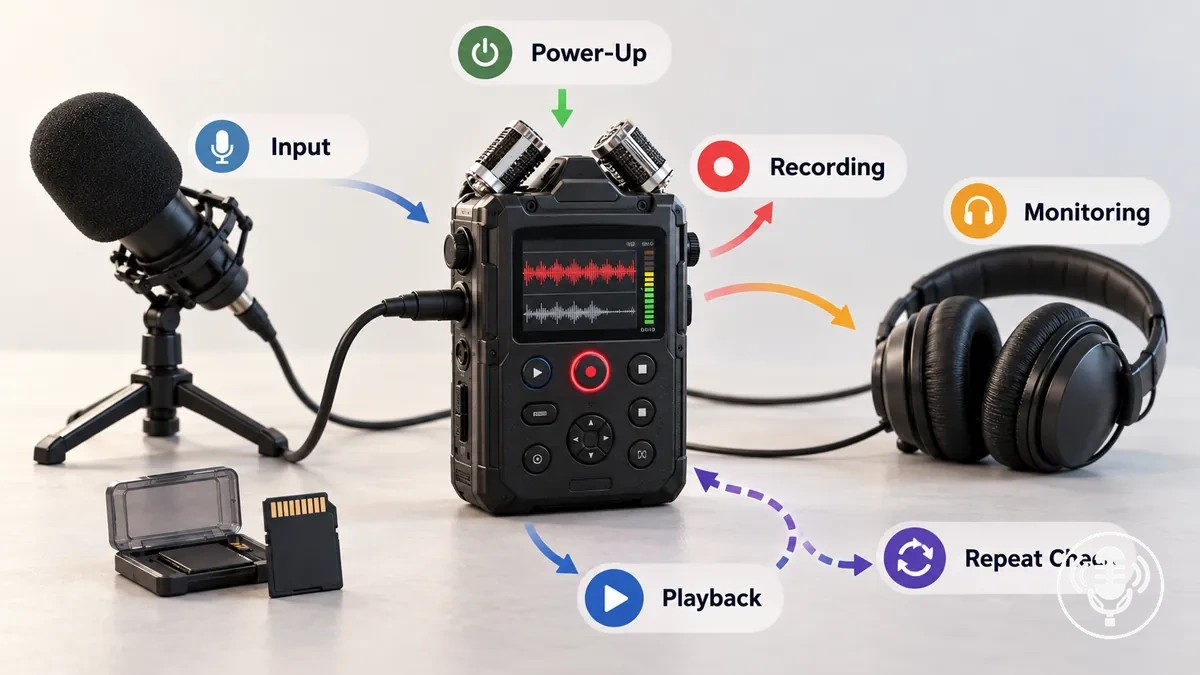
If a used recorder powers up, records, monitors, plays back and handles its supported connections and media consistently across repeat checks, those repeatable observations provide stronger buying confidence than a one-off success.
If unstable power, noisy controls, a failed supported channel, inconsistent media recognition or other intermittent behaviour recurs during repeated testing, uncertainty remains even when the equipment works on another attempt.
These observations identify purchase risk rather than the root cause of a fault, so consistent operation increases buying confidence without establishing future reliability or remaining service life.
Recording, Playback, Monitoring, and Input Operation
The supported audio path should operate consistently from input response through recording, monitoring, file creation, and playback. These checks verify functional operation, not comparative sound quality, and each supported stage should remain usable across repeated record/playback cycles.
Trace the signal path: check the observed result at each supported stage so a recurring inconsistency can be located without assigning an unverified cause.
- Input operation: connect a suitable source to a supported input channel, operate its level control, and verify that the recorder responds to the incoming signal consistently.
- Recording: start and stop recording through the tested channel and verify that the recorder enters the expected recording state and completes the recording operation.
- Monitoring: where headphone monitoring is supported, connect compatible headphones and verify that the monitored signal remains present and consistent during the test.
- File creation: after recording, verify that the recorder creates a stored file that can be selected for playback.
- Playback: play the newly created file through a supported playback or monitoring path and verify that the recorded result can be played consistently across repeated record/playback cycles.
The diagram maps the supported audio path from an input source to the recorder input, recording and stored-file stage, monitoring path, and playback output.
Each stage is a separate verification point, so an observed inconsistency can be located within the path without assigning an unverified cause.
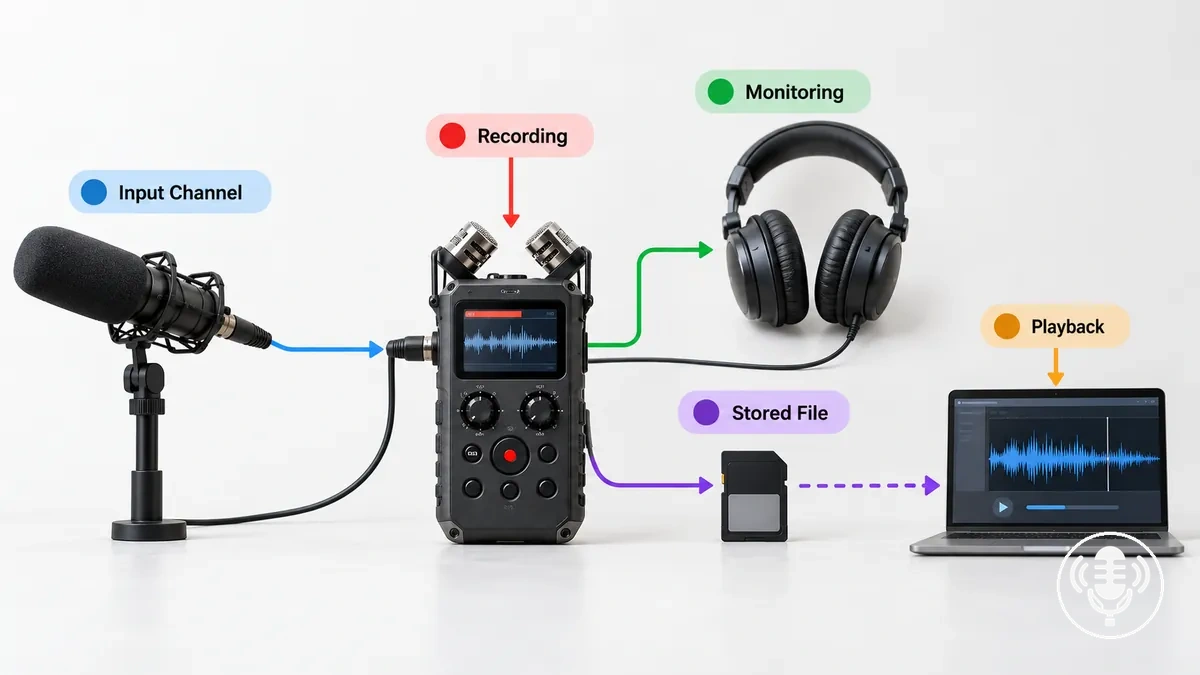
If an input channel responds inconsistently, a level control behaves intermittently, monitoring drops out, file creation fails, or playback does not consistently reproduce the recorded file, repeat the same supported test to determine whether the behaviour recurs.
Crackling, dropouts, or failed operation are relevant fault signals when they recur, but the test alone does not establish their underlying cause.
Multiple inputs or channels should be compared only when the recorder supports them, and repeatable operation across the supported audio path provides greater buying confidence than recurring functional inconsistencies.
Battery Performance, Power Stability, and Intermittent Faults
Battery condition and power stability affect used-equipment risk differently: a problem confined to replaceable cells or a rechargeable battery may create a battery-specific replacement concern, while repeated power interruption can indicate uncertainty elsewhere in the recorder's power path.
Intermittent faults should be judged by repeatable observed behaviour rather than diagnosed from one shutdown or charging event.
Expected runtime should be assessed against the specific model, battery type, temperature, load, and test conditions rather than a universal runtime threshold.
When power behaviour is inconsistent, compare the recorder across the power sources and conditions it actually supports instead of assuming that the battery is the cause.
Replaceable cells can be checked with an appropriate known-condition set, an internal rechargeable battery where present can be observed through its supported charging and operating cycle, and supported external power can provide a separate operating condition for comparison.
Battery contacts with visible corrosion, contamination, or poor contact can justify closer verification, but an observed shutdown does not by itself distinguish battery condition from a possible contact or internal power-path issue.
The next check should isolate the supported power source or condition under which the behaviour repeats rather than assign an unverified diagnosis.
Use the observed power behaviour to separate a battery-specific concern from broader power-path uncertainty and choose the next pre-purchase check.
| Observed power behaviour | Possible condition | Buying implication or next check |
|---|---|---|
| Stable operation on the tested supported power source | The tested power source and power path operate consistently under that test condition. | Repeat the relevant operating check before treating the result as evidence of power stability; one successful cycle does not establish remaining battery runtime or future reliability. |
| Shortened runtime compared with the expected behaviour for that model and test condition | Battery condition may be reduced, but the observation is also conditional on battery type, temperature, load, and use conditions. | Compare like-for-like test conditions and, for replaceable cells, repeat with an appropriate known-condition set before treating the result as a battery-specific replacement concern. |
| Irregular charging behaviour on a model with an internal rechargeable battery | The rechargeable battery, charging connection, or recorder power path may require further verification. | Repeat the model's supported charging and operating check; recurring irregularity increases uncertainty without identifying the underlying cause. |
| Unexpected shutdown during operation | The power source, battery contacts, connection, or recorder power path may be involved. | Repeat the same supported operating condition and compare another supported power source where applicable; recurring shutdown increases buying risk. |
| Power interruption associated with contact movement or inconsistent battery seating | Battery contacts may have contamination, corrosion, deformation, or an unstable physical connection. | Verify whether the interruption repeats under the same contact condition and treat recurring contact-related intermittence as unresolved power-stability risk. |
| Stable external power but unstable battery operation | The observed difference narrows the concern toward the battery, battery contacts, or battery-side power path without establishing which is responsible. | Repeat the battery-side test with the appropriate supported battery configuration; persistent instability leaves a battery-specific or recorder power-path concern that should affect the buying decision. |
If a recorder repeatedly shuts down on battery power but remains stable on supported external power, the difference associates the instability with the battery-side condition without identifying whether the battery, battery contacts, or another part of the power path is responsible.
Likewise, recurring charging behaviour that differs from the model's expected supported operation warrants further verification rather than an immediate rechargeable-battery diagnosis.
Repeated instability across more than one supported power source increases uncertainty about the recorder's power path, while a concern isolated to a verified replaceable power source can be assessed more narrowly.
The less clearly the behaviour can be isolated to a replaceable battery condition, the greater the buying risk from unresolved power instability.
Price Savings, Warranty Protection, and Remaining-Life Risk
Used field recording equipment offers stronger value only when its lower price reasonably compensates for added condition uncertainty, likely replacement needs, repair exposure, and any difference in purchase protection. The price difference alone does not establish value.
Compare the same attributes for each specific offer: upfront price, verified condition, stated warranty or return protection, included accessories, foreseeable replacement needs, and remaining-life uncertainty. Where protection is not stated, do not assume it exists.
Risk-adjusted comparison: judge the offer from the evidence and terms available before purchase, not from the new-or-used label or an assumed discount.
| Decision factor | New equipment | Used equipment | Why it matters |
|---|---|---|---|
| Upfront price | The new price is the stated price for the specific new-condition offer. | The used price is the stated price for the specific used-condition offer; price savings exist only relative to a comparable alternative. | The price difference should be weighed against condition uncertainty, protection differences, and likely follow-on costs rather than treated as value on its own. |
| Verified condition | The offered new condition can be checked against the stated condition and included items. | Verified condition depends on the physical and functional evidence available for the specific item. | Greater unresolved condition uncertainty reduces confidence that a lower purchase cost represents stronger value. |
| Warranty or return protection where offered | Any warranty or return protection has value according to the terms actually stated for the specific offer. | Warranty or return protection may be offered, limited, or absent according to the stated terms of the specific offer. | Stated purchase protection can limit some post-purchase exposure according to its terms; protection that is not stated should not be assumed. |
| Included accessories | Included accessories are the items explicitly supplied with the specific offer. | Included accessories are the items that remain with the used equipment and are explicitly stated as included. | Missing required accessories create additional replacement needs when they must be obtained separately, reducing the effective price advantage. |
| Likely replacement needs | Replacement exposure should be based on the condition and completeness of the specific new-condition offer rather than assumed to be absent. | Observed wear, missing items, or verified component condition can identify replacement needs before purchase. | Likely replacement needs reduce the practical benefit of price savings and increase the purchase's foreseeable cost exposure. |
| Remaining-life uncertainty | Remaining service life cannot be established from the new label alone. | Prior use and verified condition can leave greater uncertainty about remaining service life when their effects cannot be established before purchase. | Greater lifecycle uncertainty increases the importance of sufficient price savings, verified condition, and stated protection when judging the trade-off. |
If two comparable offers have different purchase prices, the lower used price can represent stronger value when verified condition is acceptable, included accessories are sufficient, protection terms are understood, and likely replacement needs or repair exposure do not consume the savings.
If the used equipment has unresolved condition uncertainty, missing accessories, likely replacement needs, limited protection, or uncertain remaining service life, a smaller price difference provides less compensation for that added risk.
Broader cost and value analysis can consider ownership expenses beyond this purchase-condition comparison, but the new-versus-used decision should remain focused on evidence available for the specific offers.
The stronger risk-adjusted value is therefore the offer whose price difference reasonably compensates for its condition uncertainty, protection differences, replacement needs, repair exposure, and remaining-life risk rather than whichever option simply has the lower stated price.
When New or Used Field Recording Equipment Is the Better Choice
New equipment is generally the better fit when reducing condition uncertainty and downtime risk matters more than the possible saving. Used equipment can be the better fit when relevant condition and operation are sufficiently verified and the saving justifies the remaining risk.
Neither purchase condition is inherently better for every buyer. Match the decision to risk tolerance, verification confidence, the protection actually offered, foreseeable replacement exposure, and how costly an interruption would be for the intended use.
Priority map: use each factor below to decide which purchase condition better matches the actual use case.
- Condition tolerance
- new equipment tends to fit a buyer with low tolerance for uncertainty about prior wear, while used equipment becomes more reasonable when its relevant condition can be sufficiently verified before purchase.
- Verification confidence
- used equipment becomes more reasonable when available condition evidence and functional checks provide sufficient confidence in observed operation; limited verification increases the case for new equipment as the lower-uncertainty option.
- Warranty or return protection
- where a new offer provides materially clearer warranty or return protection than the used offer, new equipment can better suit a buyer who places greater weight on post-purchase protection; only the terms actually offered should affect the decision.
- Budget pressure
- used equipment can be the stronger-value choice when its price savings materially help the budget and reasonably compensate for the remaining condition and lifecycle uncertainty.
- Replacement needs
- new equipment becomes more attractive when likely replacement needs materially reduce the used option's price advantage; used equipment remains more competitive when foreseeable replacement exposure is limited relative to the savings.
- Downtime sensitivity
- a buyer who cannot readily absorb uncertain interruptions has more reason to favour the purchase condition with stronger verification and protection, while a buyer able to tolerate more uncertainty can give greater weight to the savings of a sufficiently verified used option.
If lower acquisition cost and lower uncertainty point in different directions, rank the decision factors by the real use case rather than allowing model features to displace the purchase-condition decision.
Final rule: favour new when lower uncertainty, available protection, and downtime sensitivity outweigh the used saving; favour used when verified condition and repeatable operation provide sufficient confidence and the saving reasonably compensates for replacement exposure and remaining risk.