
Field Recording Equipment Durability: Build Quality, Ruggedness, and Reliability
Field recording equipment is durable when it continues to perform its intended function under the mechanical, environmental, and repeated-use stresses relevant to the recording job. Judge ruggedness from model-specific construction, stated operating limits, declared ratings or tests, and condition-matched field evidence—not from weight, a metal enclosure, or vague “rugged” wording alone.
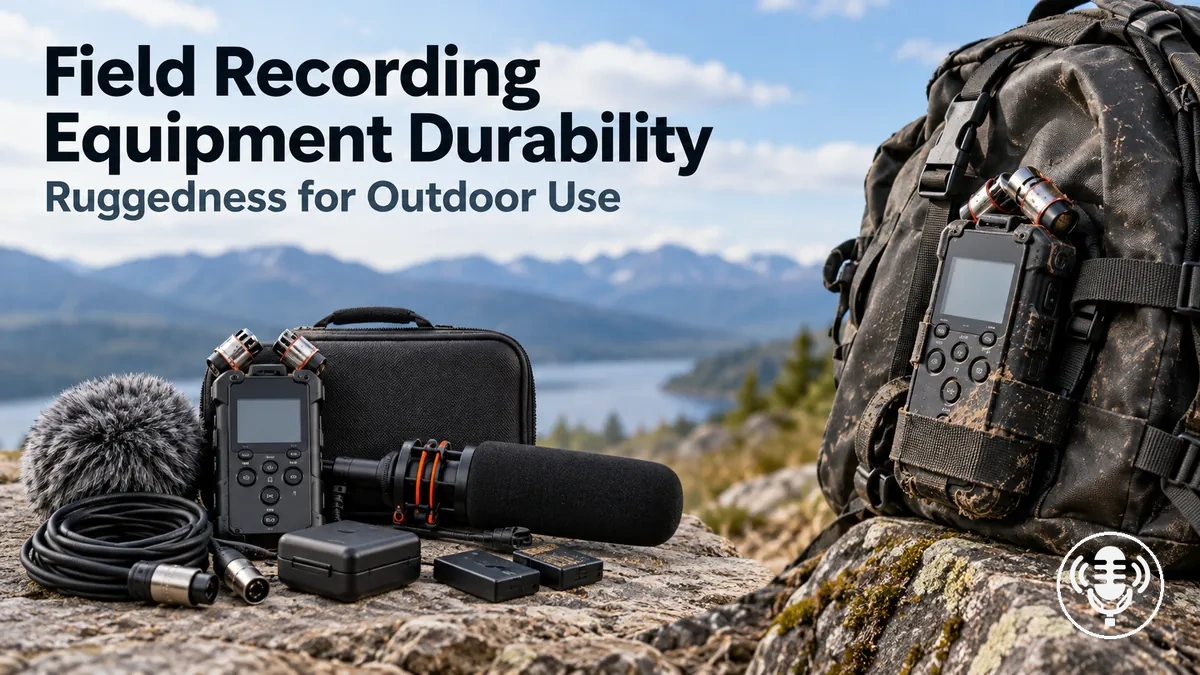
Decision support
Durability decision matrix
Match the field stress to evidence that names a condition or boundary. A rugged appearance is a construction cue; it is not a durability rating.
- Mechanical stress
- Verify: enclosure, controls, connectors and mounts against the relevant drop, bump, shock or vibration condition. Prefer a model-specific test, specification or condition-matched field evidence.
- Heat and cold
- Verify: the model’s stated operating-temperature range for the intended use. Keep storage limits separate from operating limits and do not transfer another model’s range.
- Moisture
- Verify: the declared weather, water or ingress-protection condition. Seals and “weather-resistant” wording do not by themselves establish immersion or waterproof capability.
- Repeated use
- Verify: functional wear at controls, connectors, doors, mounts and cable interfaces. Cosmetic wear matters less than looseness, intermittent contact, poor closure or unstable mounting.
Decision rule: choose equipment whose documented capability covers the stresses you actually expect, then use cases or covers as supplemental protection rather than as a substitute for the device’s native rating.
Durability is broader than ruggedness: build quality describes construction, ruggedness describes resistance to demanding stresses, and reliability describes consistent function through repeated use.
Treat every durability claim together with the condition that limits it. Surviving an undocumented exposure does not create a new operating limit, and accessory protection does not change a device’s native environmental rating unless that assembled configuration is explicitly documented.
Table of Contents
What Durability and Ruggedness Mean for Field Recording Equipment
Field recording equipment durability is the capacity of a recorder, microphone, or related component to retain its intended function under the operating conditions and stresses relevant to its use.
The applicable durability level is conditional on the equipment's physical construction, specified operating conditions, and the stresses it encounters rather than on appearance or promotional wording.
Four related durability concepts
- Durability
- Retention of intended function under the stresses and operating conditions relevant to use.
- Ruggedness
- Resistance to demanding physical or environmental stresses without loss of intended function.
- Build quality
- Physical construction of the enclosure, controls, connectors, doors and mounting areas.
- Reliability
- Dependable, consistent operation under the conditions and repeated use being considered.
Visible construction can provide build-quality cues, but those cues alone do not establish how a field recorder or microphone will perform under a particular impact, temperature, moisture, or repeated-use condition.
The illustration below uses durability and ruggedness to identify visible construction areas without treating their appearance as proof of resistance, because confusing these attributes can turn a construction impression into an unsupported ruggedness or reliability claim.

A heavier or more solid-looking recorder is not automatically more durable, because weight and appearance do not establish resistance or dependable operation under specified conditions.
Likewise, weather-resistant should not be treated as synonymous with waterproof unless an applicable rating or test supports that claim; weather resistance, outdoor suitability, and protective procedures can influence durability decisions, but they remain separate concepts.
Physical Build Quality Under Drops, Bumps, Vibration, and Repeated Handling
Physical build quality affects whether a field recorder or microphone retains structural integrity and continued operation when handling exposes it to bumps, drops, vibration, or rough contact.
Bump resistance and shock resistance are conditional attributes: their practical value depends on the enclosure design, protection of vulnerable parts, and the severity and direction of the mechanical stress.
A rugged or solid build can provide visible construction cues, but those cues alone do not establish resistance under stated conditions.
Vulnerable areas include recorder housings, microphone bodies, controls, connectors, doors, and mounting points.
During field handling, an impact at an enclosure edge places a different mechanical load on equipment than vibration transmitted through a mount or a bump against a protruding control or connected plug.
Physical build quality under drops, bumps, vibration, and repeated handling is therefore most useful when each exposed part is considered together with its construction and the possible operational consequence if that area is displaced, cracked, loosened, or otherwise impaired.
The annotated image identifies these exposed areas, while the table maps each part to its construction attribute, acute stress condition, and possible effect on operation.

| Part or area | Construction attribute | Stress condition | Possible operational effect |
|---|---|---|---|
| Recorder housing | Enclosure structure and protection around edges and internal assemblies | Drop or direct bump affecting the housing | Surface marking can remain cosmetic, while deformation or cracking can impair controls, connectors, alignment, or internal assemblies if the stress reaches those areas. |
| Microphone body | Body construction and protection around the capsule or internal assembly | Impact or rough handling of the microphone | Surface scuffing can remain cosmetic, while deformation or internal displacement can impair intended microphone operation. |
| Controls | Recessing, guarding, support, and attachment of knobs, switches, buttons, or dials | Direct bump or impact on a protruding control | Displacement, breakage, or jamming can limit access to the function operated by that control. |
| Connectors and doors | Connector support, surrounding enclosure structure, and hinge or latch construction | Bump to a connected plug, connector area, battery door, or media door | Misalignment, cracking, or loss of secure closure can interfere with connection, access, or normal operation. |
| Mounting points | Attachment structure and support around the mount | Vibration, bump, or sudden load transmitted through attached equipment | Loosening, deformation, or loss of alignment can reduce attachment stability or alter the mounted component's position. |
A metal enclosure, greater weight, thicker-looking casing, or other solid build cue is not proof that a field recorder has greater shock resistance, because actual resistance also depends on structural design, vulnerable interfaces, stress conditions, and applicable evidence.
Visible construction cues show where physical protection may be concentrated, whereas a specific ruggedness claim requires evidence of resistance under stated conditions.
Repeated connection-cycle wear belongs primarily to longer-term reliability rather than this acute-stress comparison.
Cosmetic scuffs or dents should therefore be distinguished from functional damage that impairs controls, connections, mounting, structural integrity, or continued operation.
Environmental Durability and Operating Limits
Environmental durability is the ability of field recording equipment to remain operational within the environmental conditions declared for the particular model.
A field recorder or microphone should therefore be evaluated against its stated operating limits rather than a universal environmental threshold or a general rugged description.
The relevant operating envelope is model- and condition-specific, with temperature and moisture forming the two main environmental dimensions considered here.
Declared operating conditions and defined environmental ratings provide stronger decision signals than vague rugged or weather-resistant language because they identify the conditions to which a capability applies.
Environmental durability and operating limits should therefore be checked against the conditions stated for the particular equipment, including any qualification attached to a resistance claim.
The illustration below shows temperature and moisture as conditions around the equipment rather than as proof of unrestricted environmental resistance, and remaining operational within declared conditions is different from merely surviving an exposure.

Operating-envelope checks
- Declared operating range: use the temperature or other operating range stated for the specific field recorder, microphone, or component rather than transferring a limit from another model.
- Moisture or weather-resistance claim: treat the stated claim as conditional on its defined exposure and limitations; weather-resistant wording alone does not establish waterproof capability without a supporting rating or test.
- Test or rating condition: when a manufacturer supplies a defined rating or test condition, interpret the resistance claim within that stated scope rather than as protection from every exposure.
- Operation versus survival: equipment that remains physically intact after an exposure has not necessarily demonstrated reliable operation during or after that condition.
- Explicit limitations: apply stated exclusions, operating restrictions, and condition-specific limitations to the environmental claim they qualify.
In field conditions, cold, heat, humidity, or light moisture can place equipment outside its intended operating envelope when the relevant exposure exceeds the model's declared limits or resistance conditions.
A report that a field recorder survived a particular exposure is observational evidence of that event, not a guaranteed operating boundary for the model or for field recording equipment generally.
Environmental durability is therefore one boundary for outdoor suitability; broader outdoor selection depends on requirements beyond durability, while detailed temperature behavior, moisture resistance, and protection procedures remain separate considerations.
Heat, Cold, and Operating Temperature Ranges
There is no single operating-temperature range that applies to all field recording equipment because the stated limits vary by field recorder, microphone, and component.
The usable temperature range for a particular device is therefore the operating range documented for that model and condition; without a device-specific specification, a numerical limit should not be assumed or transferred from another recorder or microphone.
Heat, cold, and operating temperature ranges should be interpreted through those model-specific stated limits rather than as universal boundaries.

In cold or freezing conditions, a field recorder, display, microphone, or another component can encounter a temperature-sensitive limitation before a different component does; heat can likewise expose a component-specific operating limit.
Operation observed outside a stated range does not establish reliable operation there, and a storage range, when the manufacturer provides one, should not be treated as the operating range.
The image illustrates contrasting hot and cold conditions rather than a performance specification, while the following checks separate the temperature conditions that should be verified for the particular equipment.
Temperature checks
- Stated operating range: use the documented operating temperature range for the specific field recorder, microphone, or component under the stated conditions; do not extrapolate another model's limits.
- Storage range: use a separate storage-temperature range only when it is explicitly provided for that equipment, and keep it distinct from limits for operation.
- Low-temperature behaviour: near or beyond a model's stated low-temperature limit, treat display, control, or other component behaviour as device-specific unless documentation or reliable field observations establish the particular effect and condition.
- High-temperature behaviour: near or beyond a model's stated high-temperature limit, treat changes in component operation or reliability as device-specific unless documentation or reliable field observations establish the particular effect and condition.
Moisture and Weather-Resistance Ratings
Weather-resistant, water-resistant, and waterproof wording for a field recorder or microphone should be interpreted through the declared rating or test condition attached to the specific equipment.
A moisture claim establishes only the protection described for that condition; vague wording does not establish an ingress-protection level, exposure duration, or immersion capability.
These terms should therefore not be treated as synonyms unless the documented conditions establish equivalent protection.
Sealing around an enclosure, connector opening, control, or microphone body can form part of a device's moisture resistance, but visible sealing alone does not establish a rating.
A declared ingress-protection rating is meaningful only within the ingress conditions and test basis represented by that specific rating; without a stated rating or test condition, no particular level of moisture protection should be inferred.
Moisture and weather-resistance ratings should therefore be read claim by claim, with the supported exposure and limitation kept together.
The image highlights enclosure and sealing areas under light moisture to show where protection can matter without representing those visible features as certification.

How to read an IP code
When a device carries an IP code, the first code position describes protection against solid-particle ingress and the second describes protection against water ingress. An X in either position means that the code does not specify a rating for that position; it does not mean “zero protection”. Use the documentation for the exact code to interpret the tested exposure and its limits.
| Claim or rating | Supported exposure or test condition | Practical meaning | Limitation |
|---|---|---|---|
| Weather-resistant | Only the weather exposure explicitly stated for the particular device | Indicates protection within the declared weather conditions | The wording alone does not establish an ingress rating, immersion protection, or protection from unstated moisture exposure. |
| Water-resistant | Only the water exposure or test condition explicitly stated for the particular device | Indicates resistance to the specified water exposure under the declared conditions | The claim does not establish protection for a different exposure, duration, or immersion condition unless that condition is also stated. |
| Waterproof | Only the water exposure covered by the applicable declared rating or documented test condition | Indicates protection within the specific water condition established by that documentation | The word alone does not establish unlimited protection from moisture or every form of water exposure. |
| Declared ingress-protection rating | The ingress conditions represented by the specific stated rating | Provides a defined basis for interpreting enclosure protection within those represented conditions | An unstated ingress rating cannot be inferred from enclosure appearance, sealing, or a general resistance claim. |
A protection claim does not automatically mean that a field recorder, microphone body, connector, or enclosure is protected against every form of moisture, humidity, rain, or immersion.
The useful distinction is between claim wording and a documented protection condition: the documented condition defines the exposure to which the durability implication applies, while survival during an undocumented field exposure does not establish a new rating.
Detailed weather and moisture protection procedures remain outside this rating-interpretation subsection.
Reliability During Repeated Field Use
Reliability during repeated field use is the ability of field recording equipment to continue performing its intended functions consistently as normal handling, transport, connection, and adjustment are repeated over time.
It concerns cumulative functional condition rather than whether a recorder or microphone survives a single impact.
No fixed service life should be assumed from robust construction alone because continued reliability also depends on the condition of repeatedly operated parts and interfaces.
During repeated handling, controls are operated, connectors and cable interfaces are coupled and uncoupled, doors are opened and closed, and mounts are loaded and adjusted.
Wear at these recurring contact or movement points becomes relevant when an observable change such as looseness, poor retention, intermittent contact, sticking, or loss of secure closure affects continued operation.
Reliability during repeated field use can therefore be assessed through recurring wear points that connect observable condition with a possible operational consequence:
Functional wear points
- Controls: secure controls that actuate consistently indicate retained functional condition; looseness, sticking, or inconsistent actuation can interfere with reliable adjustment.
- Connectors: connectors that retain plugs securely and maintain consistent contact support dependable operation; looseness, physical movement, or intermittent contact can disrupt an attached microphone, cable, or other interface.
- Doors and latches: doors that close and latch securely retain their intended access and closure function; hinge wear, weak latching, or poor alignment can impair that function.
- Mounts: mounting points that remain secure and correctly aligned support stable attachment; loosening, thread wear, or deformation can reduce attachment stability.
- Cable interfaces: cable and socket interfaces that maintain secure mechanical and electrical contact support continued signal or power connection; intermittent contact during normal connection or movement indicates function-relevant deterioration.
- Other repeatedly handled parts: switches, covers, fasteners, and similar parts remain useful reliability signals when their observable condition shows whether repeated use has changed operation, retention, alignment, or secure fit.
Robust construction and reliable interfaces are useful reliability signals when their observable condition supports continued intended operation or when applicable documentation provides stronger evidence.
Repeated-use field observations are more informative when they identify the affected part, its wear state, and the operational consequence rather than relying on an isolated account of long service.
Scratches, finish wear, and similar cosmetic ageing do not by themselves establish functional deterioration, whereas looseness, intermittent contact, impaired actuation, poor closure, or unstable mounting become function-relevant when they affect the corresponding operation.
For equipment with substantial prior field use, cumulative condition becomes especially important when comparing new versus used equipment because examples of the same model can have different histories of handling, connection cycles, and interface wear.
Observable functional condition and documented maintenance or use history can inform a long-term reliability decision, but neither establishes a fixed remaining service life nor guarantees future operation.
Evaluating Durability Claims and Specifications
A durability claim for field recording equipment is decision-useful when it identifies the durability attribute and ties that attribute to a specification, test condition, operating limit, or credible field evidence.
A stated value or condition defines what the claim covers, while its limitation defines where that meaning stops.
Build quality or ruggedness wording without those boundaries provides less specific information for judging expected durability.
Vague rugged terminology can describe a general design intention without identifying the stress, operating limit, or test condition to which the claim applies.
Evaluating durability claims and specifications therefore means checking the claim source, the stated test or use context, and its limitation before applying it to field use.
Specific, condition-bound information provides a clearer decision signal than an unqualified descriptor, while repeated field observations can add context when the equipment and observed conditions are identifiable.
The criteria table organizes these claim types by evidence quality and decision meaning.
| Claim or specification | Evidence source | Condition or test context | Limitation | Decision meaning |
|---|---|---|---|---|
| Manufacturer specification or operating limit | Official documentation for the specific field recording equipment | The operating condition, environmental boundary, or other condition stated with the specification | Applies to the documented attribute and stated conditions; performance outside those conditions is not established by the specification | Compare the documented limit with the intended field condition to determine whether the stated capability covers that use |
| Declared rating or stated test | Documentation identifying the rating or test applied to the specific equipment | The exposure, procedure, or test condition explicitly associated with the declared rating or result | Supports the durability attribute only within the conditions represented by the declared rating or stated test; a broader capability or unstated standard should not be inferred | Use the declared condition to judge whether the tested attribute is relevant to the expected field exposure |
| Sustained field evidence | Repeated observations from relevant field use with identifiable equipment and conditions | The handling, environment, repeated-use pattern, and other relevant context described with the observations | Real-world observations can include uncontrolled variables and do not establish an undocumented operating limit, rating, or universal outcome | Use context-rich repeated observations to assess behaviour under comparable field use while retaining uncertainty about different conditions |
| General ruggedness or build quality wording | Product description, construction description, or visible construction cues | No defined stress or use condition unless one is separately stated | Does not by itself establish a measurable resistance level, operating limit, declared rating, or test result | Treat the wording as a preliminary construction signal and seek a defined attribute, condition, specification, stated test, or relevant field evidence before relying on it |
A specification gives a documented value or condition for an identified durability attribute, while a declared rating or stated test connects the attribute to the conditions represented by that rating or test.
Sustained field evidence can show how field recording equipment behaved during repeated real-world use, but its decision value increases when the equipment, relevant conditions, and observed outcome are clearly identified.
The strongest signals are therefore specific and condition-bound, while vague ruggedness language and observations without adequate context retain greater uncertainty.
For equipment expected to face demanding transport, repeated handling, or environmental exposure, compare the relevant durability claim with the conditions of the intended recording work before using it as a selection criterion.
Durability remains one criterion within choosing field recording equipment, so specifications, stated tests, build quality, ruggedness, and relevant field evidence should inform the decision without turning any single evidence class into a universal model ranking.
Rated Ruggedness Versus Real-World Field Evidence
Rated ruggedness and real-world field evidence answer different questions about field recording equipment durability.
Rated or declared evidence establishes the attribute and tested conditions stated for the equipment, so its repeatability and relevance remain bounded by that test boundary.
Field evidence records an observation under an actual exposure condition and duration, but a single observation does not establish repeatability or create a formal rating.
Rated ruggedness versus real-world field evidence is therefore a comparison between condition-defined capability and observed behaviour in a documented use context.
| Rated or declared evidence | Real-world field evidence |
|---|---|
| Definition: A declared durability attribute linked to a stated rating, test, specification, or operating condition. | Definition: An observation of equipment behaviour during identifiable field use and exposure. |
| Repeatability: A defined test provides a basis for comparison when the same stated procedure and tested conditions are applied. | Repeatability: Repeated observations under comparable conditions provide more support than one report, while differences between field situations limit direct replication. |
| Condition specificity: The claim applies to the exposure condition and test boundary actually declared; it should not be extended to unstated conditions or durations. | Condition specificity: The observation applies to the equipment, exposure condition, duration, handling, and other relevant circumstances actually reported. |
| Typical limitation: A stated rating or test does not establish durability beyond the conditions it represents. | Typical limitation: Field observations can contain uncontrolled variables, and observed survival does not establish an undeclared rating or test result. |
| Decision use: Compare the declared test or operating condition with the intended field exposure to judge whether the documented capability is relevant. | Decision use: Compare repeated observations from similar use contexts with the intended exposure to judge whether observed behaviour is consistent with the documented capability. |
When rated ruggedness covers an intended exposure and repeated field observations under comparable conditions agree with the declared evidence, that agreement can increase confidence that the documented capability is relevant to the intended use.
When observations diverge, differences in exposure condition, duration, handling, equipment configuration, or other context can explain why field behaviour does not match the tested conditions.
A mismatch does not by itself invalidate the declared evidence, while agreement does not extend a rating beyond its stated limitation.
The durability decision should therefore preserve both the formal test boundary and the uncertainty attached to field observation rather than treating either evidence class as universal proof.
Built-In Ruggedness Versus Protective Cases and Covers
Built-in ruggedness and a protective case or cover address overlapping but not identical risks for field recording equipment.
Built-in ruggedness comes from native device attributes such as the enclosure, sealing, and guarded controls that remain part of the equipment during field use.
A fitted case or cover may add abrasion protection or impact protection during handling or transport when its construction, coverage, and fit are appropriate to that exposure.
Built-in ruggedness versus protective cases and covers therefore separates native durability from accessory-assisted protection rather than treating the two as equivalent.
| Built-in ruggedness | Protective cases and covers |
|---|---|
| Protection source: Protection is inherent to the equipment through attributes such as its enclosure construction, built-in sealing, and guarded or recessed controls. | Protection source: Protection is external to the equipment and depends on the protective case or cover construction, coverage, and fit. |
| When it applies: Native protective attributes remain part of the equipment during field use within the conditions stated for the device. | When it applies: Accessory protection applies while the case or cover is fitted or while the equipment is enclosed for the handling or transport condition the accessory is designed to address. |
| Typical exposure addressed: Enclosure construction, sealing, and guarded controls can address physical or environmental exposure only to the extent established for the device under its stated conditions. | Typical exposure addressed: A suitable case or cover may reduce abrasion from contact or buffer some handling and impact exposure during transport, with the protection bounded by its construction, coverage, fit, and stated use conditions. |
| Limitation: Built-in ruggedness does not establish protection from exposure beyond the device's documented capability or stated conditions. | Limitation: Accessory protection does not establish protection for openings, controls, connectors, impacts, or environmental exposure outside the conditions the case or cover is documented to address. |
| Effect on the device's native rating: The device's native rating or declared capability remains the condition-bound reference for its built-in protection. | Effect on the device's native rating: Adding a protective case or cover does not change the device's native rating unless a separate documented claim explicitly establishes a capability for the relevant assembled configuration and condition. |
During field use, built-in enclosure construction, sealing, and guarded controls remain available while the equipment is being operated, whereas a protective case intended for transport may provide its relevant protection while the recorder or microphone is enclosed and being carried.
A cover that remains fitted during operation may reduce particular abrasion or handling exposure, while impact protection remains conditional on its construction, fit, coverage, and the actual impact condition.
The practical trade-off is therefore between protection inherent to the equipment and external protection targeted at particular handling or transport risks.
A protective case or cover does not change the field recording equipment's native environmental rating unless a separate documented claim establishes otherwise for the relevant configuration and condition.